Reports, Scores & Protections

Why Did My Credit Score Drop 50 Points? 9 Hidden Reasons

Discover 9 hidden reasons why your credit score dropped 50 points, from utilization to inquiries. Learn how to diagnose the cause and start rebuilding today.

CreditRoost Team
18 min

Key Takeaways

  • A 50-point drop indicates a significant change in credit factors, often related to utilization, new accounts, or payment history.
  • Hidden reasons can include new inquiries, closed old accounts, becoming an authorized user on a troubled account, or unreported errors.
  • The first step is always to get your free credit reports from all three bureaus to pinpoint the exact cause.
  • Avoid quick fixes; a strategic, sequenced plan focusing on utilization, on-time payments, and building durable credit is essential.
  • While AU tradelines may support short-term credit visibility for some profiles, long-term credit health still depends on your own consistent habits and account quality.
  • Monitor your credit regularly to catch changes early and avoid preventable setbacks.

Quick Summary

A sudden 50-point credit score drop can feel alarming, but it is often a clear signal that one key credit factor changed. Identifying the exact cause, from utilization shifts to new inquiries or even identity theft, is the crucial first step to recovery.

Example Post-Drop Score Zone

640/850
A 50-point slide usually means at least one major factor moved.
300 (Poor)850 (Excellent)

The right response starts with diagnosis, not panic.
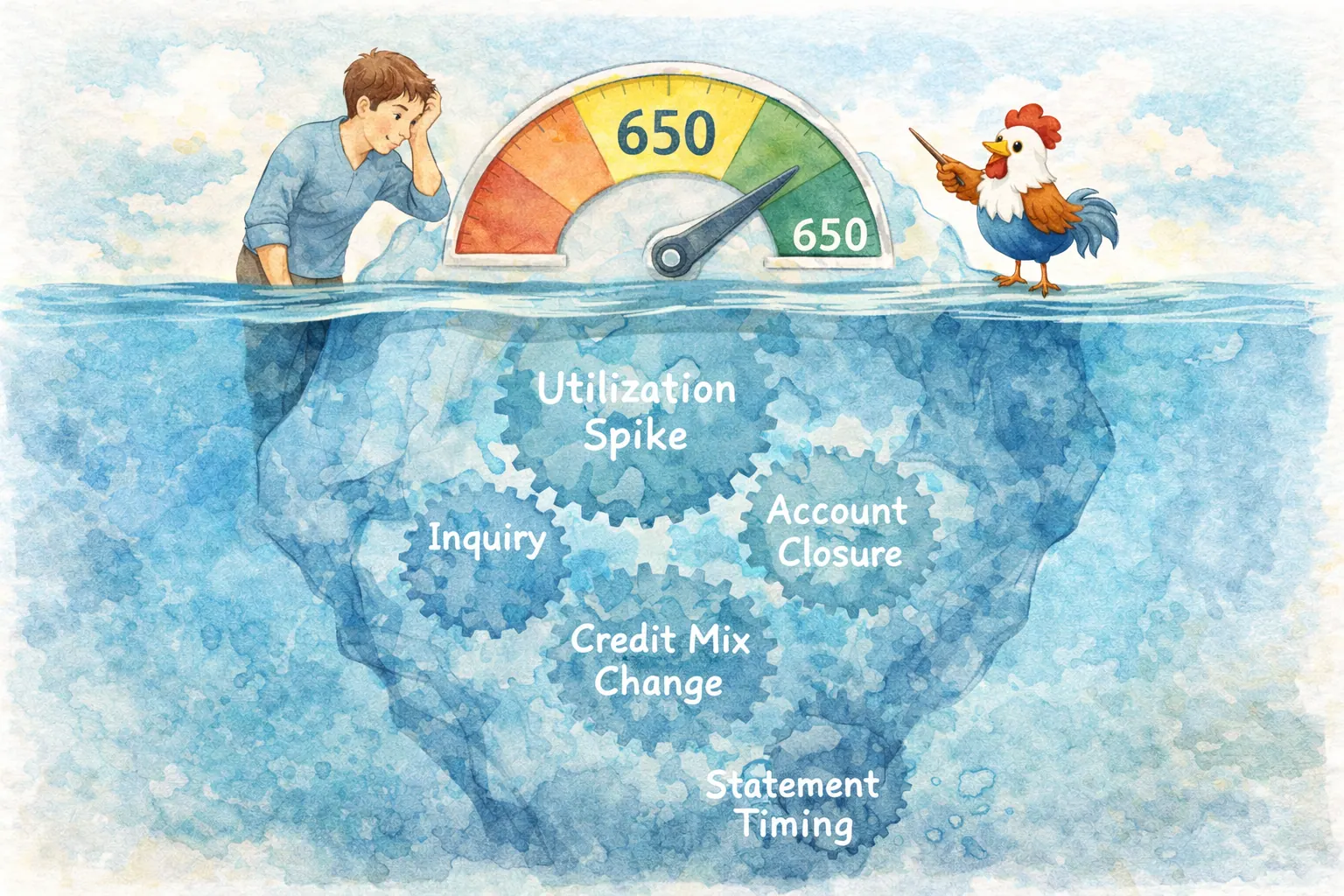
Why Did My Credit Score Drop 50 Points? 9 Hidden Reasons

Imagine, for a moment, that your financial nest, which you have been diligently building, feels a little shaky. You have been gathering twigs of on-time payments, weaving in sturdy branches of low utilization, and nurturing the younger parts of your credit history. Then a sudden gust, a 50-point score drop, knocks a key piece out of place and leaves you wondering what changed.

Illustration for article: Why Did My Credit Score Drop 50 Points

You can do everything "mostly right," then still open your app and see a 50-point drop. That is frustrating, and honestly, it feels unfair in the moment. Most of the time, though, there is a concrete reason in your report data, not a random scoring glitch.

A 50-point credit score drop often indicates a notable shift in one or more of the core factors that build your credit profile, signaling it is time to investigate your credit reports immediately.

It is a common moment of panic for newcomers building their first file and rebuilders who have been doing well for months. A drop this size can change loan pricing, approvals, and rental decisions. The good news is that once you identify the trigger, recovery is usually straightforward.

Unearthing the Mystery: 9 Hidden Reasons Your Score Might Tumble

Understanding why your credit score dipped is like being a detective for your finances. You are looking for clues, subtle changes that might not jump out at first glance but have a significant impact on your credit health. Many people assume they have not done anything wrong, but often a drop stems from less obvious actions or reporting delays. A disciplined three-bureau review process helps you catch these shifts early.

Most Common Hidden Triggers

1
Utilization spike before statement close
2
New hard inquiries in a short window
3
Closure of an older account
4
30+ day late payment reported
5
Collection or public record update
6
Identity theft or bureau data errors

Most drops trace back to one or more of these patterns.

1. A Sudden Jump in Credit Utilization

This is perhaps the most common culprit, yet it often feels hidden because you might not perceive a significant change in your spending. Credit utilization is the amount of credit you are currently using compared to your total available credit. If your utilization ratio goes up, even if you are paying bills on time, your score can suffer. Lenders like to see you using less than 30% of your available credit, and ideally under 10% for optimal scores.

For example, Riley, a rebuilder, had been meticulously keeping her credit card balance low. One month, she had an unexpected car repair and put $1,500 on a card with a $3,000 limit. Even though she paid it off in full a week later, the card company reported the higher balance before her payment. Her utilization temporarily jumped from 5% to 50%, causing a swift score drop. This highlights the importance of understanding your statement closing dates versus your payment due dates. Paying a large balance before the statement closes ensures a lower utilization is reported.

2. Opening a New Credit Account (Hard Inquiry)

Every time you apply for new credit - a credit card, a car loan, a mortgage - a hard inquiry is placed on your credit report. This signals to lenders that you are seeking more credit, which can be seen as a slight risk, especially if you have several inquiries in a short period. A single hard inquiry might cause a small dip (a few points), but multiple inquiries can lead to a more noticeable drop, like 50 points. These inquiries typically stay on your report for two years, impacting your score for about 12 months.

Nico, a newcomer, felt great after getting his first secured credit card and seeing his score rise. A few months later, he needed a new phone and applied for a carrier plan that required a credit check, and then decided to apply for a store credit card for a discount on a new TV. These two applications within a month resulted in two hard inquiries, causing his nascent credit score to dip significantly, much to his surprise.

3. An Old Credit Account Was Closed

Closing an old credit card might feel like a responsible financial move, especially if you are trying to simplify your finances. However, it can unintentionally hurt your score. When an account closes, it reduces your total available credit, which can instantly increase your credit utilization ratio if you have balances on other cards. Moreover, closing an old account shortens your average age of accounts, a factor that significantly contributes to your credit history length - one of the most impactful elements of your score.

In practice, older accounts act like stability signals. Closing one can make your profile look newer and riskier, even if your spending habits did not change.

Think of it like removing one of the oldest branches from a nest: the structure can still hold, but it may look less established to outside observers.

Statement Date vs Due Date

Your due date is when payment is required to avoid a late fee. Your statement date is when balance data is captured and reported.

If you pay after statement close, your report may still show high utilization even though you paid on time.

4. A Late Payment (Even 30 Days Past Due)

This might not feel hidden, but its impact can be surprisingly large, especially if it is your first late payment. A payment reported just 30 days past its due date can cause a significant score drop - often 50 points or more - because payment history is the single most important factor in your credit score (accounting for 35% of your FICO score).

Even if you usually pay on time, one missed bill in a busy month can create a real score drop. That is why autopay and reminders are not optional for most rebuild plans.

5. New Public Records or Collections Appearing

Sometimes a debt you thought was resolved, or one you forgot about, appears as a collection or public record (like a judgment). That can damage your score quickly and stay for years. A common version is an older medical balance sold to a new collector and then reported again.

6. Identity Theft or Reporting Errors

This is a truly hidden reason, and one of the most frustrating. Errors can crop up on your credit report, or worse, someone could be using your identity to open accounts. Unauthorized accounts, incorrect late payments, or inflated balances can all dramatically pull down your score. Since you are not aware of these actions, the score drop seems to come out of nowhere.

This is why routine report checks matter. You are entitled to a free credit report from each major bureau (Equifax, Experian, and TransUnion) once every 12 months at AnnualCreditReport.com. These reports are the fastest way to spot fraud and reporting mistakes.

They are also your primary tools for making sure your profile is free from uninvited errors, stale data, or unauthorized account activity.

Warning

Fraud and Error Alert

If accounts or inquiries appear that you do not recognize, do not wait for the next cycle. Dispute quickly and lock down access before additional damage reports.

7. Becoming an Authorized User on a Bad Account

While becoming an Authorized User (AU) on a well-managed account may help some profiles add positive payment history, the reverse is also true. If the primary cardholder on an account where you are an AU starts making late payments or maxes out the card, that negative activity can reflect on your credit report, causing your score to drop.

This is why choosing an AU account requires care. You are partially tying your file to someone else's behavior. AU tradelines can improve visibility for some profiles, but durable results still come from your own accounts and payment history. Set expectations with realistic AU score movement ranges.
Important

Disclosure

Some lenders and credit scoring models may filter out, discount, or weigh authorized user tradelines differently in their underwriting decisions. Results vary based on lender policies, the specific scoring model used, and your unique credit profile. An AU tradeline does not guarantee loan approval or any specific credit score outcome.

8. Inactivity on Existing Accounts Leading to Closure

It might seem counterintuitive, but sometimes not using your credit can hurt it. If you have credit cards that you rarely use, the issuer might decide to close the account due to inactivity. As discussed with closing old accounts, this reduces your total available credit and can shorten your average age of accounts, leading to a score drop. It is often a good strategy to use your oldest cards for small, recurring purchases and pay them off immediately to keep them active and reporting positive history.

9. Mortgage or Auto Loan Paid Off or Refinanced

While paying off a major loan like a mortgage or car loan is a huge financial accomplishment, it can sometimes lead to a temporary dip in your credit score. When the loan is paid off, that account is closed. This means you lose a strong positive account from your credit mix (the different types of credit you have), and potentially reduce your average account age if it was one of your oldest accounts. Similarly, refinancing a loan introduces a new hard inquiry and can change the age of your active accounts.

Did your drop happen after a high reported balance, or after a late/derogatory update?

Utilization issue
If utilization drove the drop, prioritize balance reduction before the next statement close.
Derogatory issue
If negative marks drove the drop, prioritize correction, payment recovery, and timeline control.

Start with the branch that matches your report data, then sequence actions around it.

Real-Life Scenarios: How These Drops Play Out

Let us look at how these hidden reasons can impact people like Nico, the newcomer, and Riley, the rebuilder, and someone facing a time-sensitive financial need.

Nico's New Credit Jitters: Nico, proud of his 700+ score built from a single secured card and rent reporting, decided it was time to move into his own apartment. He applied for three apartments in quick succession, each requiring a credit check. The landlords, seeing multiple new hard inquiries from his applications and a slight increase in his secured card utilization (he bought some furniture), suddenly saw a 55-point drop. He learned that while he was doing well with building credit, rapid applications and slight utilization changes could cause temporary setbacks, especially with a still-thin credit file. This is where he could have benefited from ensuring his secured card balance was extra low before applying for the apartments, and spacing out applications where possible.

Riley's Unexpected Emergency: Riley had carefully nursed her credit score back up into the mid-600s after some past financial struggles. She had been keeping her two credit cards mostly clear, occasionally using one for gas and paying it off immediately. Then, her air conditioner broke in the middle of summer. She put the $2,000 repair bill on her card with a $2,500 limit. Even though she planned to pay it off with her next two paychecks, the high utilization (80%) was reported, and her score dropped by 60 points. This was a critical lesson: even temporary high utilization can cause significant damage, especially for rebuilders with lower credit limits.

The Home Buyer's Blunder: A couple, excited to buy their first home, had excellent credit scores. Just before closing, one spouse applied for a new store credit card to get a discount on appliances for their new home. The hard inquiry and the new account slightly lowered their score, but more critically, the lender re-pulled their credit just before closing. The 50-point dip, combined with an already tight debt-to-income ratio, nearly jeopardized their mortgage approval. They learned the hard way that it is crucial to avoid any new credit applications or significant financial changes in the months leading up to a major loan.

Your Credit Journey: A Lifelong Flight

Seeing your score drop is discouraging, but it is usually a diagnostic moment, not a dead end. Once you identify the reason, you can make targeted changes. Your credit affects much more than loans; it also affects rent, jobs, insurance pricing, and more.

Take control by checking your reports, identifying the cause, and following a clear plan. If you stay consistent across billing cycles, scores usually recover and become less volatile over time.

1
Monthly

Pre-close balance review

Lower card balances 5-7 days before statements close.

2
Monthly

Payment controls audit

Verify autopay, backup funding, and due-date reminders.

3
Quarterly

Three-bureau report check

Look for stale data, suspicious inquiries, and account errors.

4
As needed

Stability reset

If cash flow tightens, rebuild reserves before new credit actions.

This maintenance rhythm helps preserve gains after your score rebounds.

With patience and consistency, you are not just repairing short-term damage. You are building a stronger, more resilient profile that can better withstand future financial stress.

Disclaimer: The information provided in this article is for educational purposes only and does not constitute financial, legal, or professional advice. Credit reporting practices and scoring models may change over time. Please consult a qualified professional for personalized guidance.

Frequently Asked Questions

1. What is the most common reason for a 50-point credit score drop?

  • The most common reason for a sudden 50-point drop is a significant increase in credit utilization. Other frequent causes include new inquiries, late payments, or closure of an older account.

2. Can a single late payment cause a 50-point score drop?

  • Yes. A payment reported 30+ days late can cause a large drop, especially if it is your first late mark, because payment history is heavily weighted in most scoring models.

3. How quickly can I recover a 50-point credit score drop?

  • It depends on the cause. Utilization-driven drops can rebound faster after balances report lower. Late payments and inquiry clusters usually need more months of clean behavior.

4. Is a 50-point credit score drop normal?

  • Small score movement is normal. A 50-point change is usually a meaningful signal tied to new debt pressure, a negative mark, or several recent inquiries.

5. What is the first thing I should do if my score drops?

  • Pull and review all three reports (Experian, Equifax, and TransUnion) at AnnualCreditReport.com to identify the exact trigger before taking action.

6. Can checking my credit score too much lower it?

  • No. Checking your own score is a soft inquiry and does not lower your score. Hard inquiries from new credit applications can cause temporary dips.

7. Do closed accounts hurt my credit score?

  • They can. Closing an account can raise utilization and reduce average account age, both of which may pressure scores, especially on thinner files.

Share article