Key Takeaways
- Utilization is the percentage of your available credit that you're currently using, and it accounts for roughly 30% of your credit score.
- Keeping your utilization low, ideally below 30% and even better below 10%, signals financial health and responsibility.
- Strategic mid-cycle payments and judicious use of multiple cards are effective tactics to manage and lower your reported utilization.
- A higher credit score through good utilization can unlock better rates for loans, mortgages, and other financial opportunities.
- While utilization is a powerful reinforcer, establishing initial credit visibility often benefits from gateway tools like authorized user tradelines, followed by durable builders like secured cards and credit-builder loans.
What Exactly Is Utilization? The Foundation of Your Financial Nest
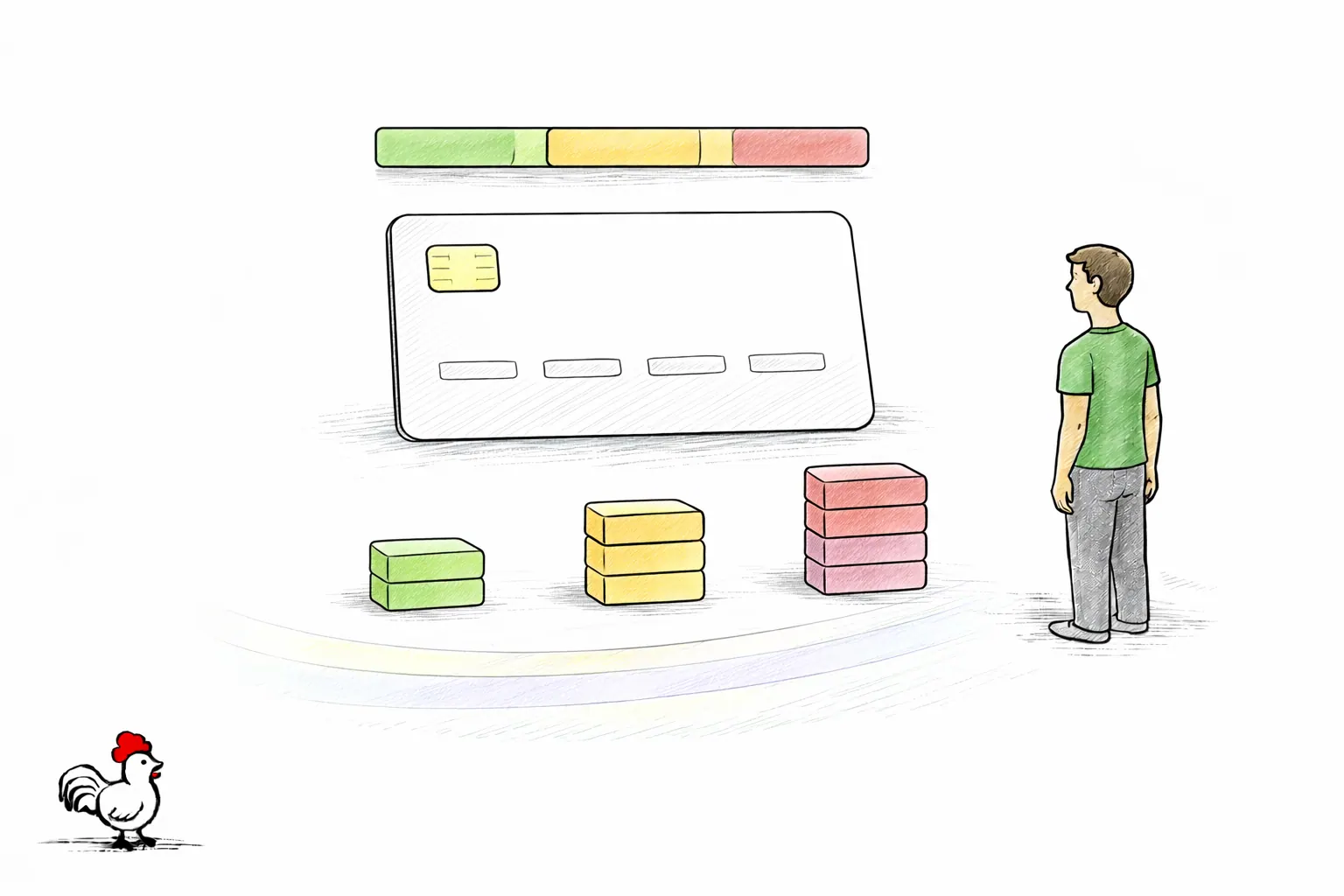
At its simplest, your utilization ratio is a snapshot of how much of your credit you're actually using. Think of it like this: if you have a credit card with a $1,000 limit, and your current balance is $300, your utilization for that card is 30%.
credit utilization ratio
The percentage of your total available credit that you are currently using. It's calculated by dividing your total credit card balances by your total credit limits, and is a major factor in your credit score.
If you have multiple cards, the credit scoring models also look at your overall utilization across all your accounts. For example, if you have two cards, one with a $1,000 limit and a $300 balance, and another with a $2,000 limit and a $100 balance, your total available credit is $3,000 ($1,000 + $2,000) and your total used credit is $400 ($300 + $100). Your overall utilization would be roughly 13.3% ($400/$3,000).
This percentage is incredibly important because it accounts for a significant portion of your FICO score, approximately 30%. Lenders view high utilization as a red flag, indicating that you might be over-reliant on credit or potentially struggling financially. Conversely, low utilization suggests you're a responsible borrower who can manage credit well without maxing out available limits. Many experts refer to "The 30% Rule," advising you to keep reported balances below 30% of your credit limit on any single card and across all cards combined. While this is a good starting point, aiming even lower, ideally under 10%, often yields the best results for your score.
The Silent Score Killer: Why High Utilization Hurts Your Score
When your credit utilization ratio creeps up, it sends a clear, often negative, message to lenders. Imagine a bird trying to build a magnificent nest, but constantly trying to perch too many heavy items on one small branch. Eventually, that branch might sag. Similarly, a high utilization ratio suggests to potential lenders that your financial 'branch' could be under strain.
This perception can lead to several undesirable outcomes. First, your credit score will likely drop because utilization is such a significant factor. Second, when you apply for new credit, whether it's a car loan, a mortgage, or another credit card, lenders will see that high utilization. They might deny your application or offer less favorable terms, such as higher interest rates. They often interpret a high balance as a sign that you need credit to make ends meet, rather than using it as a convenient payment tool.
Tactics to Keep Your Plate from Overflowing: Strategic Nest-Building
- Pay balances before the statement closes (mid-cycle)
- Keep utilization under 10% for maximum boost
- Request limit increases to lower your ratio naturally
- Spread expenses across multiple cards
- Wait until the due date to pay (balance already reported!)
- Max out one card while others sit empty
- Close old credit cards (reduces total limit)
- Obsess over 0% utilization on every single card
Mid-Cycle Payments: The Game Changer
One of the most effective strategies is to make payments throughout your billing cycle, not just once a month when your statement arrives. Most credit card companies report your balance to the credit bureaus around the time your statement closes. If you wait until the due date, which is typically after the statement has closed, the higher balance will already have been reported. By making mid-cycle payments, you can pay down a significant portion of your balance before your statement even generates. This ensures that the low balance is what gets reported to the credit bureaus, quickly improving your utilization ratio.
Spending Period
Using your card for daily expenses.
Mid-Cycle Payment
Pay balance down to under 10% of limit.
Statement Closes
Low balance is reported to bureaus.
Boost Recorded
Your credit score reflects the low utilization.
Leveraging Multiple Cards (Wisely)
Requesting Credit Limit Increases
Another powerful, though less direct, method to lower your utilization is to increase your total available credit. If your credit limit on a card goes from $1,000 to $2,000, and your spending remains the same at $300, your utilization quickly drops from 30% to 15%. However, proceed with caution: only request a credit limit increase if you are confident it won't tempt you to spend more. The goal is to lower the ratio, not to increase your debt. Also, note that some credit card issuers may perform a hard inquiry when you request an increase, which can temporarily ding your score.
The 'Zero Balance' Myth: A Nuance
"0% utilization is always the absolute best for your score."
1-9% utilization is often slightly better than 0%.
Why It Matters
Scoring models reward 'active responsibility.' A tiny reported balance (AZEO method) shows you use credit, whereas 0% on all cards can look like inactivity. Just pay it off immediately after it reports!
Real-World Nest Scenarios: Putting Utilization into Practice
Let's consider a few situations to see how mastering utilization can make a tangible difference in the real world of credit building.
Utilization Action Plans
Newcomer Nico
First $500 secured card. Spending $200/mo.
Rebuilder Riley
One card at 90% utilization ($900/$1000).
Tina (Home Buyer)
Applying for mortgage in 90 days.
-
Newcomer Nico, the First Secured Card User: Nico is a newcomer to credit, having just secured their first secured credit card with a modest $500 limit. They use the card for essential groceries and gas, totaling about $200 each month. If Nico simply waits until the statement due date to pay the full $200, their card will report 40% utilization ($200/$500) to the credit bureaus. This is above the recommended 30% threshold and could hinder their score growth. Instead, Nico sets up a reminder to pay $150 mid-cycle, a week before the statement closes. Now, only $50 is reported, resulting in a healthy 10% utilization ($50/$500). By consistently doing this, Nico establishes a strong foundation of responsible credit use, building a robust credit history quickly.
-
Rebuilder Riley, the Maxed-Out Card Manager: Riley is working to rebuild their credit after some past financial struggles. They have three credit cards: Card A with a $1,000 limit and a $900 balance (90% utilization), Card B with a $2,000 limit and a $100 balance (5% utilization), and Card C with a $3,000 limit and a $200 balance (6.7% utilization). Their overall utilization is high: ($900 + $100 + $200) / ($1,000 + $2,000 + $3,000) = $1,200 / $6,000 = 20%. While 20% isn't terrible, the 90% utilization on Card A is dragging their score down significantly. Riley's best strategy is to focus all available extra funds on paying down Card A as quickly as possible. Even reducing Card A's balance to $300 (30% utilization) would dramatically improve both the individual card's ratio and their overall score, signaling to lenders that they're actively managing debt.
-
Time-Sensitive Tina, the Mortgage Applicant: Tina is planning to apply for a mortgage in three months and knows her credit score needs to be in top shape to qualify for the best rates. She currently has a good score, but her utilization hovers around 25%. To optimize, Tina decides to aggressively pay down all her credit card balances to less than 5% before each billing cycle closes for the next three months. This hyper-low utilization will give her score the maximum possible boost, making her a more attractive candidate for a mortgage lender and potentially saving her thousands of dollars in interest over the life of the loan. She understands that this short-term sacrifice is a strategic investment in her financial future.
Beyond the Ratio: A Holistic View of Your Credit Nest
While managing your utilization ratio is undeniably effective, it's essential to remember that it is one piece of a larger puzzle, your complete credit profile. Your credit score is a reflection of several factors, each contributing to the stability of your financial nest.
Disclosure
Some lenders and credit scoring models may filter out, discount, or weigh authorized user tradelines differently in their underwriting decisions. Results vary based on lender policies, the specific scoring model used, and your unique credit profile. An AU tradeline does not guarantee loan approval or any specific credit score outcome.
Your Action Plan for a Healthier Utilization Ratio
Ready to take control of your utilization and boost your score? Here’s a simple action plan to guide you:
Inventory
Know your limits and current balances for every card.
The 10% Habit
Adopt mid-cycle payments to report low balances.
Limit Expansion
Strategically request increases to lower ratios.
Verification
Verify reported balances on your credit report.
Action Checklist:
- Know Your Limits and Balances: Keep a close eye on your credit limits and current balances for each card. Awareness is the first step to control.
- Adopt Mid-Cycle Payments: Make it a habit to pay down a significant portion of your balance (or even the full amount) before your statement closing date. This ensures a low balance is reported.
- Target Under 30%, Aim for Under 10%: Consistently strive to keep your utilization below 30% for all cards, and push for under 10% on your most active cards for optimal score benefits.
- Strategically Request Credit Limit Increases: If you have a solid payment history and trust yourself not to overspend, consider asking for a limit increase to lower your ratio. Be mindful of potential hard inquiries.
- Review Your Credit Report Regularly: Check your credit report from all three bureaus annually (or more frequently via credit monitoring services) to ensure reported balances are accurate and reflect your efforts. Learn how to read your credit report to spot any errors or discrepancies.
Building a Stronger Nest, One Smart Habit at a Time
Managing your credit utilization ratio is an ongoing practice of mindful credit management. Each time you make a strategic payment and keep your balances low, you're strengthening the foundation of your financial nest. This dedication can lead to better interest rates, easier approvals, and greater financial freedom.
Frequently Asked Questions
1. What is a good credit utilization ratio to aim for?
- Ideally, you should aim to keep your credit utilization ratio below 30% on each card and overall. However, for optimal credit score benefits, aiming for under 10% is even better and signals exceptional financial management to lenders.
2. How often do credit card companies report utilization to credit bureaus?
- Most credit card companies report your balance to the credit bureaus around the time your monthly statement closes. This is why making mid-cycle payments can be so effective in lowering your reported utilization.
3. Will paying off my credit card balance in full every month result in 0% utilization?
- Not necessarily. If you pay your balance in full after your statement closes, the higher balance will likely have already been reported to the credit bureaus. To ensure a very low or 0% reported utilization, you would need to pay down your balance before the statement closing date.
4. Can increasing my credit limit help my utilization ratio?
- Yes, if your spending habits remain the same, an increase in your credit limit will automatically lower your utilization ratio because you'll have more available credit relative to your balance. However, only request an increase if you trust yourself not to overspend.
5. Is 0% utilization always the best for my credit score?
- While very low utilization is excellent, some credit scoring models slightly favor consumers who show some active, responsible use of credit. Reporting a very small balance (e.g., 1-9%) on at least one card can sometimes be marginally better than 0% across all cards, signaling active management.
6. How quickly can managing my utilization impact my credit score?
- Credit utilization is a dynamic factor, meaning changes can be reflected relatively quickly. If you significantly lower your reported balances, you could see a positive impact on your credit score within one to two billing cycles.
7. How does authorized user tradelines relate to utilization?
- When you become an authorized user on an account, that account's credit limit and balance (and thus its utilization) can be added to your credit report. If the primary user has a long history of low utilization on that card, it can quickly improve your reported utilization, which is especially beneficial for those with thin credit files.