Key Takeaways
- A 100-point increase is possible for some profiles, but outcomes vary by starting file and behavior.
- Most stalled rebuilds trace back to missed payments, high utilization, or unplanned credit applications.
- Reviewing all three reports first prevents wasted effort and helps prioritize high-impact actions.
- Authorized user tradelines may help visibility for some files, but they are not guaranteed and should be paired with your own builders.
- Sustained progress usually comes from on-time payments, lower balances, and steady monitoring.
Why Some People Gain 100 Points and Others Stall
A large increase is easier when the file has reversible issues, such as high card utilization or report errors, and harder when there are recent late payments or multiple serious delinquencies. In both cases, the process starts the same way: pull all three reports and diagnose precisely.
Most scoring models are still anchored to five factors: payment history (about 35%), amounts owed/utilization (about 30%), length of history (about 15%), new credit activity (about 10%), and credit mix (about 10%). This is why one tactical change is rarely enough by itself.
Typical Early Rebuild Zone
This score snapshot is directional, not a promise. It shows why sequence and consistency matter more than one-time tactics.
When your diagnosis is clear, your actions become measurable. That is when progress tends to pick up.
The Biggest Mistakes That Delay Score Growth
Most people do not fail because they do nothing. They fail because they do the wrong things too early.
Credit Rebuild Discipline
- Confirm the root cause across all three reports.
- Focus on payment consistency and low utilization first.
- Add new accounts only when they fit a defined sequence.
- Open multiple accounts to chase quick score spikes.
- Close old accounts without checking utilization impact.
- Trust guaranteed score promises from marketing claims.
These are the specific mistakes I keep seeing:
1. Skipping report-level diagnosis
- Without full report review, people treat the wrong problem and lose months.
- If you want a cleaner process, use a report-reading checklist before taking action.
2. Paying attention only to due dates, not statement balances
- A card can be paid on time and still report high utilization.
3. Applying for too much credit at once
- Inquiry clusters and new-account risk can offset small wins.
- Review inquiry timing carefully before submitting additional applications.
4. Closing aged accounts too quickly
- This can reduce available credit and increase overall utilization.
- Review closure tradeoffs and account-age impact before shutting old cards.
5. Believing claims of guaranteed increases
- There is no universal guarantee for any score outcome.
6. Using one tactic without a full sequence
- One change rarely creates durable movement without support habits.
7. Stopping monitoring after early gains
- Reporting errors, stale balances, or new issues can reverse progress.
If you want a quick view of what usually blocks momentum first, use this priority order:
Most Common Rebuild Blockers
When these factors stack together, progress slows fast even when effort is high.
The Sequence That Usually Works Better
Large movement usually comes from sequencing, not intensity.
Step 1
Review all three reports and dispute clear inaccuracies.
Step 2
Stabilize every payment and bring revolving balances down.
Step 3
Add one durable builder if your file needs fresh positive data.
Step 4
Track reporting updates and adjust one variable at a time.
The core rule is simple: address what carries the highest scoring weight before adding complexity.
- Payment history first. Repeated on-time reporting matters more than one-time tactics. See payment history fundamentals.
- Utilization second. Keep balances controlled before statement close dates. Under 30% is a common baseline, and under 10% is often stronger when feasible. Use utilization benchmarks and rapid utilization reduction tactics.
- Then add builders. If needed, use secured credit builders and related tools to create fresh positive records.
Once the structure is set, change one variable at a time so you can see what is actually working.
Are your current score drops mostly from high balances and missed history, or from thin-file limitations?
Durable Builders After Initial Visibility
AU visibility can be helpful for some profiles, but long-term strength usually comes from your own tradelines and payment behavior.
- Secured cards: Useful when you need controlled revolving history. Keep usage low and pay in full when possible.
- Credit-builder loans: Helpful for adding installment history with predictable on-time reporting. See credit-builder loan basics.
- Rent reporting: Can add recurring positive data for thin files. See rent reporting context.
This is where many 100-point attempts either stabilize or stall. If you use one gateway tactic but skip your own builder stack, gains may fade.
Three practical scenarios from the original planning draft are worth keeping in view:
- Nico (thin file): Used AU visibility as a first step, then added his own positive reporting to avoid depending on one account.
- Riley (rebuild after setbacks): Combined payment cleanup with a secured card, a small builder loan, and rent reporting; progress became visible over consecutive cycles.
- Maria (time-sensitive goal): Focused first on utilization reduction, then added one durable builder to support a near-term loan timeline.
These scenarios are illustrative, not guarantees. The point is sequence: visibility first when needed, then durable self-owned data.
Where AU Tradelines Help and Where They Do Not
Authorized user tradelines can improve visibility for some files by adding account age and available credit context. That can matter, especially when the file is thin. Results still vary, and some lenders weigh AU data differently.
Thin file
A credit profile with limited account depth or short history, which can increase score volatility.
Thin files may benefit from one durable builder plus stable low-utilization usage over several cycles.
This is why file depth and behavior quality should be evaluated together before adding complexity.
Disclosure
Some lenders and credit scoring models may filter out, discount, or weigh authorized user tradelines differently in underwriting decisions. Results vary based on lender policies, the specific scoring model used, and your unique credit profile. An AU tradeline does not guarantee loan approval or any specific credit score outcome.
Tradelines can be a supporting tactic. Durable progress still comes from your own payment and balance behavior.
How to Protect a 100-Point Gain If You Get It
A major score increase is useful only if you can keep it.
Monthly
Verify all autopay settings and catch failed payments before they age.
Monthly
Review card balances before statement dates, not only at due dates.
Quarterly
Check all bureaus for stale data, new errors, and unexpected inquiries.
As needed
If cash flow pressure rises, stabilize spending and reserves before adding credit complexity.
Hitting at least three of these four controls consistently is often enough to keep gains from leaking away.
Action Checklist Before Your Next Application
Before You Apply Again
- Confirm all three reports are accurate and updated.
- Bring revolving utilization to a controlled range before statements close.
- Keep every account current for multiple consecutive cycles.
- Avoid unnecessary applications during your rebuild window.
- Use one measured plan and review progress on a fixed schedule.
- Pair visibility tactics with your own durable builders (secured card, installment builder, or rent reporting).
For files where it happens, a 100-point increase is rarely one trick. It is a sequence of controlled improvements that become visible over time.
Think of this as architecture, not a hack. AU tradelines may offer faster visibility for some files, but lasting results usually come from your own on-time history, low utilization, and consistent monitoring across all three reports.
Extended Guidance from the Full Raw Response
The original raw response added a crucial point that is easy to miss: the first weeks after a score drop are usually the highest-leverage window. If you diagnose the exact cause early, you prevent months of low-impact activity.
In practical terms, this means reviewing all three bureaus, identifying what changed, and then applying a sequence that matches that root cause. A utilization problem needs a utilization response. A late-payment problem needs payment controls first. A thin-file problem usually needs additional positive data and time.
The raw draft also emphasized four high-risk moves that repeatedly delay recoveries:
- Opening too many new accounts in a short window, creating inquiry clusters and new-account risk.
- Closing old accounts that still contribute age and available credit.
- Ignoring statement-close utilization while only focusing on due-date payments.
- Trusting guaranteed-score marketing claims instead of measurable process steps.
None of these mistakes are rare. Most rebuild stalls include at least one of them.
The full strategy from the raw response was organized as a sequenced roadmap:
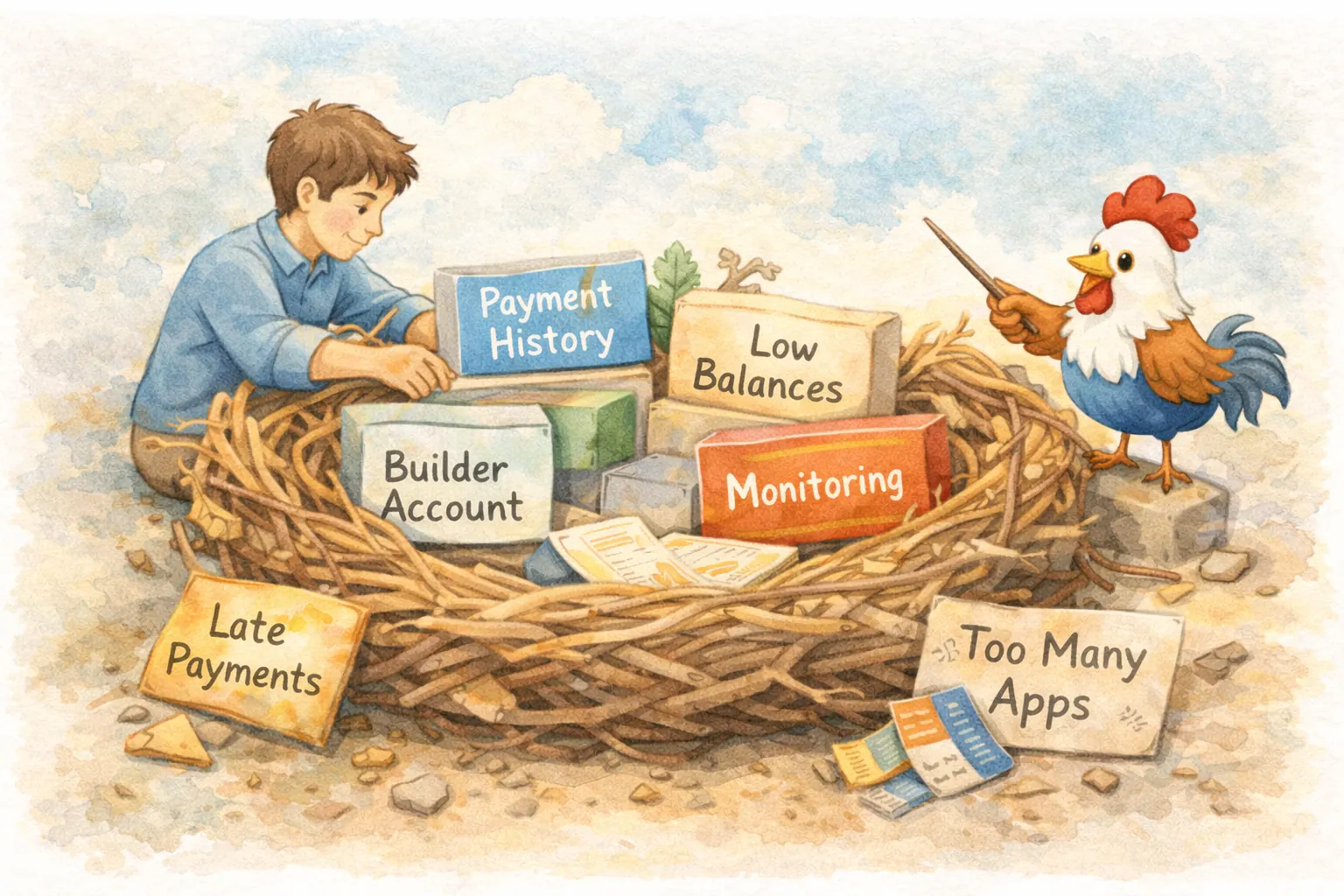
Phase 1: Gateway visibility and immediate signal improvement
For some files, especially thin files or recent rebuilds, AU tradelines can create earlier visibility by adding age and available credit context. That is why the raw response positioned AU as a gateway and not an endpoint.
Phase 2: Durable builders you own
The raw response was clear that gateway visibility should be followed by self-owned credit strength:
- secured card usage with low reported balances,
- consistent installment reporting through credit-builder loans,
- recurring positive data via rent reporting.
Riley’s scenario in the raw draft reflected this: after an early visibility boost, she stacked secured-card controls, a small builder loan, and rent reporting, then held the process steady long enough for new positive data to dilute old negatives.
Phase 3: Reinforcers that keep gains from leaking
The raw response reinforced the same long-run rules:
- protect payment history first,
- keep revolving utilization low month after month,
- monitor all three reports continuously,
- avoid reactive applications during recovery windows.
Another raw-response point worth preserving: improvements must be verified bureau by bureau. One bureau updating does not prove all three have updated. If your profile is being evaluated soon, this timing mismatch can materially affect outcomes.
The time-sensitive scenario (Maria) in the raw draft showed how this looks under deadline pressure: she reduced utilization first, added one builder for fresh positive reporting, and reviewed updates across all bureaus on a fixed cadence. In that case, the score trajectory improved fast enough to support a near-term application timeline.
Use this condensed action stack from the raw response when you need clarity:
Raw-Response Priority Stack
- Diagnose first: pull and compare all three reports before changing tactics.
- Attack utilization early: lower balances before statement close dates.
- Protect payment history with automation and monthly verification.
- Use gateway visibility only as part of a larger sequence.
- Add durable self-owned builders and monitor bureau-by-bureau progress.
A 100-point move is not guaranteed, but the raw response and field outcomes pointed to the same conclusion: speed comes from correct sequencing, and durability comes from repeatable habits.
Frequently Asked Questions
1. Can everyone raise a score by 100 points?
- Not everyone. Some profiles can, others may need longer timelines or see smaller changes first.
2. What should I fix first for faster movement?
- Usually payment consistency and utilization, because those often carry the largest impact.
3. Is opening many new cards a good shortcut?
- Usually no. Too many applications can create additional risk signals.
4. Are AU tradelines guaranteed to work?
- No. They may help some files, but outcomes vary by model and lender policy.
5. How often should I review my reports during rebuild?
- Monthly for key balances and quarterly for full three-bureau audits is a practical baseline.
If your plan is clear, measured, and consistent, the score usually reflects that over time. If your plan is reactive, the score usually does too.
Your score is not just a number for one application window. It is the operating history lenders read over time. Build it like a structure you plan to keep: careful sequencing, durable habits, and regular three-bureau verification.