Key Takeaways
- Payday loans often carry triple-digit APRs that can make repayment extremely difficult.
- Title loans put your vehicle at risk because the lender can repossess it after nonpayment.
- Both products are structured to encourage repeat borrowing through short due dates and heavy fees.
- Safer alternatives include credit unions, hardship plans, local assistance, and nonprofit credit counseling.
- Emergency funds and sinking funds reduce your need for high-risk borrowing during financial shocks.
The Siren Song of Instant Cash: What Makes a Loan Predatory?
Predatory lending is not just about a high rate. It usually combines high cost with unfair design, weak underwriting, and repayment terms that prioritize lender profit over borrower recovery.
These products often target borrowers with limited savings, urgent cash needs, or reduced access to traditional credit. Under pressure, speed can easily replace comparison.
Unpacking the Mechanics of Payday Loans: The APR Abyss
Payday loans are short-term, small-dollar loans that are usually due on your next paycheck. The advertised fee may look manageable, but annualized cost is often extreme.
Annual Percentage Rate (APR)
The yearly cost of borrowing, including interest and many lender fees, expressed as a percentage.
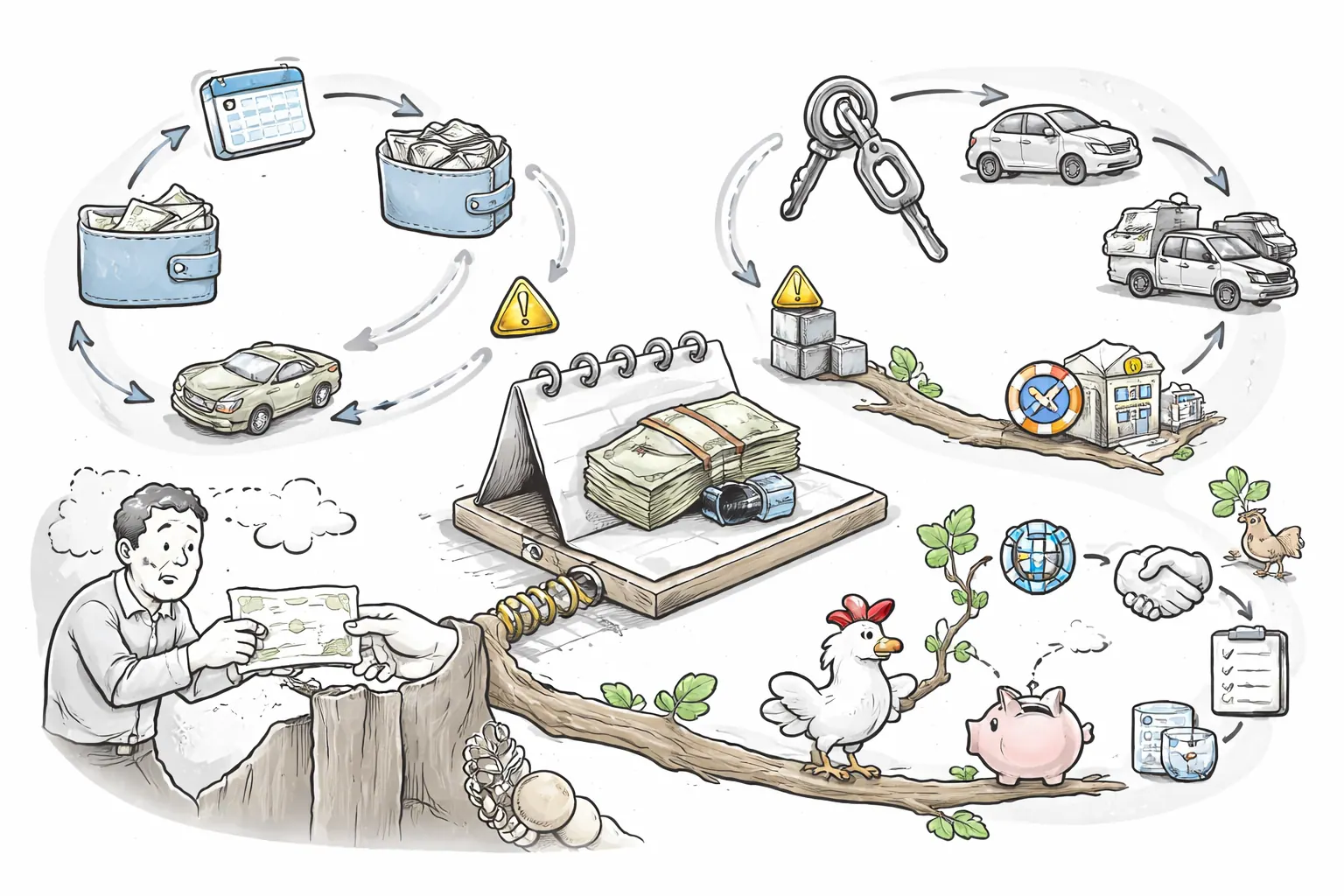
Many payday lenders require direct access to your bank account, often through a post-dated check or ACH debit authorization. On due date, they attempt full withdrawal. If funds are short, borrowers often face overdraft charges and pressure to roll the loan into another fee cycle.
Before signing, ask for full written cost disclosures: APR, finance charge, total repayment amount, due dates, and nonpayment penalties. If automatic debits are involved, keep written records of authorization terms, revocation instructions, and any stop-payment requests.
The problem is rarely one fee. The real problem is repeated fee stacking while principal barely declines.
Title Loans: Trading Your Wheels for a Vicious Cycle
Title loans are secured by your vehicle title. You borrow against your car's value, then repay on a short timeline at very high cost. In many markets, rates can exceed 300% APR and repayment is often expected in about 30 days.
When repayment fails, repossession risk can become immediate under lender terms. For many families, losing a car means losing access to work, school, childcare, and medical appointments.
The financial harm is therefore dual: expensive debt plus loss of a core income-support asset.
For title loans, read repossession terms line by line, including cure periods, storage or sale fees, and whether a deficiency balance can be pursued after vehicle sale. These rules can vary significantly by state.
That is why title-loan risk should be treated as both a financing problem and a day-to-day stability problem.
Affordability weakens as fees stack
If repayment depends on one perfect month with no income or expense surprises, the structure is fragile from day one.
The Real-Life Impact: Scenarios of the Debt Trap
Nico, the Newcomer
Nico needs $400 for urgent repairs and takes a payday loan with a $60 fee due in two weeks. At payday, rent and groceries leave too little to cover the $460 total. Nico rolls it over, pays another fee, and remains stuck near the original principal.
Riley, the Rebuilder
Riley is rebuilding credit and uses a title loan for emergency care: $1,000 borrowed against the vehicle title with a $250 fee due in one month. A planned bonus does not arrive, the due date hits, and repossession threats begin. One emergency now threatens transportation and employment.
These are not rare edge cases. They show how predatory structures can turn short-term stress into long-term instability.
Emergency hits
Borrower accepts quick-cash loan under time pressure.
Full payment due
Budget cannot absorb principal plus high fees.
Rollover or reborrow
New fees are added while core balance remains.
Collections or repossession risk
Financial and daily-life consequences compound quickly.
Finding Safer Branches: Alternatives to Predatory Loans
Safer options usually require one extra step up front, but they protect your total cost and your asset security.
- Build a mini-emergency fund to absorb small shocks. Start with emergency fund basics.
- Set up sinking funds for predictable large expenses. Use the sinking fund system.
- Ask creditors for payment plans before accounts become delinquent.
- Check local credit unions or community banks for small-dollar loan programs.
- Search local assistance for rent, utilities, food, and medical support.
- Use nonprofit counseling when debt pressure becomes systemic, and evaluate whether a debt management plan is a better structured path.
If you want structured guidance before committing, review non-profit credit counseling resources to compare support options.
As your buffer grows, target a full emergency reserve of roughly 3-6 months of essential expenses. Until then, even a $500-$1,000 starter fund can prevent many high-cost borrowing decisions.
Predatory Loan Guardrails
- Compare APR and total repayment before taking any emergency loan
- Call creditors early to request hardship terms or payment plans
- Prioritize protecting transportation and core cash-flow assets
- Treat guaranteed approval as proof that a loan is safe
- Authorize automatic withdrawals without understanding penalties
- Roll over short-term loans repeatedly without a payoff plan
Taking Flight: An Action Plan for Financial Resilience
Build a $500 mini-emergency fund
Create sinking funds for predictable bills
Map safer borrowing options in advance
Review budget monthly and reduce risk points
This follows the same principle as any risk system: small recurring controls usually beat last-minute crisis decisions.
Emergency Readiness Checklist
Run this checklist now, then revisit it every 90 days.
Need emergency cash this week?
Treat legal and asset risk as a separate checkpoint, not as a footnote after borrowing.
Disclosure
Predatory lending laws and APR caps vary by state. This educational guide is not legal or financial advice, and outcomes depend on your location, lender terms, and repayment behavior.
If collateral is involved, move from general caution to explicit downside planning.
Asset-Risk Warning
Title loans can put your vehicle at immediate repossession risk after default. If your car is essential for income, childcare, or medical care, that collateral risk must be treated as severe.
Sustainable stability rarely comes from fast, high-cost credit. It usually comes from controlled spending, emergency buffers, and early use of safer support channels.
Practical Exit Strategy if You Are Already Stuck
Many readers ask the same question: "What if I already took the loan?" If you are already in a payday or title cycle, do not chase perfection. Focus on stopping new damage first, then stabilizing.
Start by creating a 14-day triage view of your cash flow. List all income dates, all essential obligations (housing, utilities, food, transport, medicine), and every automatic withdrawal linked to the loan. This gives you a decision map so you are not reacting in the moment.
Then follow this sequence:
- Stop rollover momentum. Call the lender and request a written repayment schedule that reduces or stops rollover behavior. Ask for exact payoff amount, due date, and all fees in writing.
- Protect critical cash flow. If repeated withdrawals are triggering overdrafts, speak with your bank about blocking unauthorized debits, updating payment permissions, or replacing the account path used by the lender.
- Prioritize asset security. If this is a title loan, treat vehicle retention as mission-critical. Losing transportation can collapse income stability, which usually makes every debt outcome worse.
- Stack lower-cost support. Contact local assistance programs, creditors, and nonprofit counseling in the same week. Combined small relief sources often create enough runway to exit high-cost debt safely.
Use this priority order to limit damage first, then improve payoff efficiency.
Exit Priorities Under Pressure
This sequence helps keep housing, transport, and food stable while you work toward a formal payoff endpoint.
This approach may feel slower than a single "big fix," but it lowers the risk of cascading losses. In predatory debt, protecting fundamentals matters more than speed.
If you need to decide your first move quickly, choose the path that protects essentials before anything else.
Choose Your First Stabilization Move
Cash-Flow Shield
Freeze nonessential spending and map 14-day obligations before any new borrowing.
Lender Containment
Request a written payoff and stop rollover momentum before fees compound again.
Support Stack
Activate nonprofit counseling and local assistance in parallel to create immediate runway.
Why Payment Timing Creates a Repeat-Borrowing Trap
Predatory loans are often marketed as short-term products, but the timeline design itself traps many borrowers. The due date is usually aligned with a paycheck, yet most households have already allocated that paycheck to essential costs before the loan is due.
That creates a structural conflict:
- Your paycheck must cover rent, food, transport, and utilities.
- The lender attempts full principal plus fees at once.
- Any shortfall triggers rollover pressure, penalties, or default risk.
A quick cash-flow simulation makes that mismatch visible before damage compounds.
When the due-date bar exceeds safe cash remaining after essentials, repeat borrowing becomes more likely.
Most Common Breakpoints in the Cycle
The result is predictable math. Even disciplined borrowers can fail a due-date test if repayment design ignores real household timing. This is not only a behavior issue. It is also a product-design issue.
For title loans, timing pressure is often combined with collateral leverage. A borrower may keep paying fees to avoid repossession, even while principal barely moves. Over time, this becomes a high-cost holding pattern: cash leaves the household, but debt relief stays limited.
Payday structures create a similar loop through recurring debit attempts. If the account balance is insufficient, borrowers can face stacked overdraft charges from both lender attempts and bank penalties. That spillover can damage the exact cash-flow stability needed to exit the cycle.
The practical lesson is simple: when evaluating any emergency loan, analyze timing compatibility as carefully as APR. If your due date forces a full payoff before essentials are funded, risk is high even before the first payment cycle begins.
Consumer Protection Checklist and Documentation Trail
If you need to challenge terms, report abusive practices, or negotiate a safer settlement, documentation quality matters. Keep a running file with:
- Contract copy and all fee disclosures.
- Screenshots of payment portals and payoff quotes.
- Bank statements showing debits, returned payments, and overdraft charges.
- Call logs with date, time, representative name, and summary of promises.
- Any written request you submitted for payment plans or hardship terms.
Before you sign any high-cost emergency loan, run this legal due-diligence check:
- Confirm the lender is licensed (or otherwise authorized) in your state.
- Get all cost terms in writing: APR, finance charge, total of payments, and every fee category.
- Review default clauses: repossession timeline, collection escalation, and deficiency-balance treatment.
- Review account-debit terms: authorization scope, cancellation process, and dispute path.
- Save regulator contacts (state regulator, attorney general, CFPB/FTC) before problems begin.
If you are active-duty military or a covered dependent, ask the lender to explain how federal Military Lending Act protections are being applied to your loan terms.
Before escalating, make sure your minimum evidence pack is nearly complete so your case is easy to verify.
Then organize your materials with this matrix:
Documentation Priority Matrix
| Document | Primary use | Update cadence |
|---|---|---|
| Contract and fee disclosure | Verify legal terms and true cost | At signing and on amendments |
| Payoff quote screenshots | Track balance movement and fee changes | Each payment cycle |
| Bank debit history | Prove withdrawals, returns, and overdrafts | Weekly during crisis |
| Call and email log | Preserve commitments for escalation | After every contact |
This file does two things. First, it improves negotiation leverage because details are verifiable. Second, it protects you if you need to escalate complaints to regulators, state attorneys general, or consumer watchdog channels.
When contacting regulators or support agencies, concise facts work best: loan amount, APR or fee equivalent, number of rollover cycles, current payoff quote, and specific harm (for example overdraft cascade or repossession threat). Clear case framing usually leads to faster guidance.
If you are unsure where to begin, nonprofit counseling can help you build this documentation pack and choose the right escalation path while you continue protecting essentials.
One additional protection step is to run a weekly debt temperature check until the crisis is resolved. Track current payoff quote, number of active fees, next due date, and whether essential bills remain fully covered. This simple log shows whether your situation is truly improving or just shifting between fee categories.
Run a debt temperature check weekly until rollover risk is eliminated.
Consistent review cadence turns this from a one-time worksheet into a practical early-warning system.
If the log shows no principal progress after multiple cycles, treat that as a structural warning. At that point, prioritize a formal exit agreement and outside counseling support over ad-hoc extension decisions. Small delays can feel harmless in the moment, but repeated extensions often create the largest long-run cost.
If possible, assign one accountability partner for weekly check-ins during this phase. External accountability can reduce emotional decisions and help you stick to the exit sequence when lender pressure increases.
Frequently Asked Questions
"Guaranteed approval means the loan is safe."
Guaranteed approval without real ability-to-repay checks is usually a high-risk signal.
Why it matters
Safety comes from transparent total cost, realistic payment timing, and a viable exit path, not from instant approval language.
1. How can I spot a predatory loan quickly?
- Watch for triple-digit APRs, very short due dates, required direct account access, and marketing language like "guaranteed approval" or "no credit check" with little ability-to-repay analysis.
2. Are all high-interest loans predatory?
- No. High-interest products can still be transparent and repayable. Predatory products are defined by unfair structure, deceptive terms, and repeat-borrowing traps.
3. What if I am already in a payday or title loan cycle?
- Contact the lender to request structured repayment, then connect with nonprofit counseling immediately to build an exit plan and reduce rollover dependence.
4. Can payday and title loan defaults hurt my credit?
- Yes. Defaults may lead to collections, legal action, or repossession-related reporting, all of which may damage credit and future borrowing options. If collectors reach out, follow a debt collector response checklist to protect your rights and records.
5. Are payday and title loans legal everywhere?
- No. State rules differ widely, including rate caps and product bans. Check your state regulator for current requirements.
6. What should I do before taking any emergency loan?
- Compare true APR, fees, repayment timeline, and total cost versus alternatives such as payment plans, local assistance, or credit-union options.
7. What is the best long-term way to avoid predatory borrowing?
- Build emergency reserves, maintain sinking funds, and use a holistic credit repair framework so short-term fixes align with long-term stability.
8. Is this guide financial or legal advice?
- No. It is educational content to help you evaluate risk and make informed decisions.
9. What if a lender keeps debiting my account after I cancel authorization?
- Keep your cancellation request in writing, contact your bank quickly to place a stop payment or dispute, and preserve records for regulator complaints if debits continue.
Storms are inevitable, but durable systems change outcomes. With stronger habits and trusted support channels, you can protect your financial nest from predatory traps over the long run.