Key Takeaways
- Student loans are significant long-term financial commitments that profoundly influence your credit health.
- Repayment options range from fixed (Standard) to flexible (Income-Driven), each affecting your monthly budget and long-term interest.
- On-time payments are paramount; even one missed payment can severely damage your credit score, potentially lasting years.
- Consolidation and refinancing can simplify payments and potentially lower interest rates, but assess their specific credit implications carefully.
- Proactive communication with your loan servicer is key to managing challenges and avoiding credit mishaps.
- Effectively managing student loans is a cornerstone of a strong credit profile, setting a foundation for future financial goals.
The Weight of Your Twigs: Why Repayment Matters
The weight of these 'twigs', your student loans, can feel immense, especially as you transition from academic pursuits to adult responsibilities. Understanding how to carry them effectively is not just about making payments. It is about strategizing your repayment to minimize stress and maximize your financial well-being. This starts with understanding the various repayment options available to you, each with its own set of implications for your budget and, crucially, your credit score.
A practical way to frame your options is to compare fixed payment stability against income-based flexibility before you choose a plan.
Choosing Your Flight Path: Understanding Repayment Options
When it comes to federal student loans, you generally have a few main repayment 'flight paths' to choose from. Each path is designed to accommodate different financial situations, but they all carry distinct implications for how you manage your debt and, by extension, how it shapes your credit profile.
Use this quick sequence to evaluate plan fit before committing to one structure.
Map monthly cash flow
Start with what you can pay consistently without creating strain.
Match plan to income outlook
Choose fixed or income-adjusted payments based on realistic earnings.
Stress-test future payments
Confirm you can absorb increases before locking in the plan.
Review annually
Reassess after income or household changes.
First, there's the Standard Repayment Plan. This is often the default plan, designed to have your loan paid off within 10 years (or 10 to 30 years for consolidated loans) with fixed monthly payments. It’s like a consistent, predictable journey; you know exactly how much you need to contribute to your nest each month. This plan often results in the least amount of interest paid over the life of the loan because you’re paying it off relatively quickly. From a credit perspective, consistent, on-time payments on a standard plan build a strong payment history, which is the most significant factor in your credit score.
Next, consider the Graduated Repayment Plan. This path starts with lower payments that gradually increase over time, typically every two years, until the loan is paid off within 10 years. This can be appealing if you anticipate your income will grow steadily over your career, allowing you to start with smaller 'twigs' and gradually carry heavier ones. While it offers initial relief, you'll pay more interest over the life of the loan compared to the Standard Plan. For your credit nest, making these increasing payments on time is just as vital as with the Standard Plan; the key is to ensure you can afford the later, higher payments.
Then we arrive at the family of Income-Driven Repayment (IDR) Plans. These plans are truly flexible, adjusting your monthly payment based on your income and family size. Options include Income-Based Repayment (IBR), Pay As You Earn (PAYE), Revised Pay As You Earn (REPAYE), and Income-Contingent Repayment (ICR). These plans can extend your repayment term significantly, often up to 20 or 25 years, and any remaining balance might be forgiven after that period (though potentially taxable). IDR plans are a lifeline for many, ensuring your 'twig' load isn't crushing your daily financial capacity. However, lower payments often mean more interest accrues, and you’ll pay more over the long term. From a credit standpoint, as long as your payments are made on time, even if they are very low (sometimes even $0), they are reported as satisfactory, helping to maintain a healthy payment history. This is particularly crucial for newcomers like Nico, who might be fresh out of college with a modest income, needing to manage initial expenses while ensuring their loan obligations don't become a burden that leads to missed payments.
That technical distinction matters: student loans are installment debt, but their payment pressure can still shape how safely you manage revolving accounts.
When a Twig Snaps: The Fallout of Missed Payments
Just as a bird meticulously maintains its nest, you must vigilantly manage your student loan payments. Even a single missed payment can have a cascading effect on your credit nest, creating damage that can take years to mend. Here’s a closer look at what happens when a 'twig snaps':
Late Payments: Your student loan servicer typically won't report a payment as late until it's 30 days past due. Once it crosses that 30-day threshold, your servicer reports it to the major credit bureaus (Experian, Equifax, and TransUnion). This single negative mark can cause your credit score to drop significantly, sometimes by dozens, even a hundred points or more, depending on your existing credit profile. This is a severe blow, impacting your ability to get favorable rates on future loans, credit cards, or even housing and utilities.
Default: If you continue to miss payments, particularly for federal student loans, you risk going into default. For most federal loans, default occurs after 270 days of non-payment. The consequences are far more severe than just a late payment. Default can lead to wage garnishment, tax refund offset, loss of eligibility for federal aid, collection fees, and a severely damaged credit score that could take years, if not a decade, to recover. Private student loans can go into default much sooner, sometimes after just one missed payment, depending on the loan terms.
Collections: Once your loan goes into default, it's often sent to a collections agency. This adds another layer of negative reporting to your credit file and can involve aggressive collection efforts. Collection accounts are highly detrimental to your credit score and remain on your report for seven years from the date of the first delinquency.
A simple way to visualize the risk is to track the trigger timeline that lenders and servicers watch most closely.
Illustrative score after serious delinquency
Consider Nico, who graduated with a degree but landed an entry-level job that barely covered rent and living expenses. He missed a student loan payment by a few days, then another. Within two months, his servicer reported two 30-day late payments. Suddenly, his previously 'fair' credit score plummeted into the 'poor' range, making it impossible to get approved for a new apartment without a co-signer, let alone a reasonable interest rate on a car loan. Nico quickly realized the critical importance of communicating with his servicer and exploring IDR options before missing payments. His experience highlights how quickly a strong foundation can crack under the pressure of missed obligations.
The takeaway is clear: avoid missed payments at all costs. If you foresee financial difficulty, reach out to your loan servicer immediately. They can often guide you through options like deferment, forbearance, or switching to an IDR plan, which can temporarily pause or reduce payments without damaging your credit.
Reshaping the Nest: Consolidation and Refinancing
Sometimes, the arrangement of your 'twigs' (your student loans) can become unwieldy, making it difficult to maintain your nest effectively. In such cases, options like consolidation or refinancing can help reshape your repayment structure, but it’s crucial to understand their distinct pros and cons and how they impact your credit.
Federal Loan Consolidation: This process allows you to combine multiple federal student loans into a single Direct Consolidation Loan. The primary benefit is simplification: you’ll have only one monthly payment to one loan servicer. This can make management much easier and reduce the risk of missed payments. The interest rate for a consolidated loan is typically a weighted average of your original loans’ rates, rounded up to the nearest one-eighth of a percentage. Importantly, consolidation can also open the door to additional income-driven repayment plans or public service loan forgiveness (PSLF) programs that might not have been available to your original loans.
From a credit perspective, federal consolidation doesn't necessarily strengthen the factors behind your credit score directly, but it can indirectly help by simplifying your payments and making it easier to maintain a perfect payment history. It typically appears as a new loan on your credit report, and your old loans will show as 'paid' or 'closed.' This can shorten the average age of your accounts, a minor factor in your score, but the benefit of simplified payments often outweighs this.
Refinancing Private Student Loans (or Federal Loans into Private): Refinancing means taking out a new loan from a private lender to pay off one or more existing student loans. This is often done to secure a lower interest rate, change loan terms, or release a co-signer. If you have excellent credit, a stable income, and a strong debt-to-income ratio, refinancing can save you a substantial amount of money over the life of the loan.
When considering consolidation or refinancing, always look at the full picture: not just the interest rate, but also the terms, fees, and the impact on your benefits and credit. It's a strategic move to manage your 'twig' load, not a magic fix.
Use this decision filter before moving federal debt into a private structure.
Do you need federal protections like IDR and forgiveness access?
This quick check helps you avoid giving up protections that may matter more than a short-term rate reduction.
Maintaining the Roost: Strategies for Healthy Loan Management
Effectively managing your student loans is an ongoing commitment, much like maintaining a strong, comfortable nest. It requires proactive engagement and smart financial habits. Here are key strategies to keep your student loan 'twigs' in good order:
Operationalize the habits with a simple recurring maintenance rhythm.
Verify autopay and posted payment
Confirm your payment cleared and posted correctly across all loans.
Review balances and interest accrual
Check whether extra principal payments are reducing cost as expected.
Audit budget and emergency reserves
Rebalance cash flow before stress creates missed-payment risk.
Reassess repayment plan fit
Update strategy after income, household, or career changes.
Once this cadence is in place, the tactical steps below become easier to sustain.
-
Automate Payments: This is perhaps the simplest yet most effective way to prevent missed payments. Set up automatic deductions from your bank account. Many servicers even offer a small interest rate reduction (e.g., 0.25%) for doing so. This ensures your payments are always on time, steadily building that crucial payment history.
-
Stay in Communication with Your Servicer: If you anticipate any financial hardship, reach out to your loan servicer before you miss a payment. They are there to help you explore options like deferment, forbearance, or switching to an income-driven repayment plan. Ignoring the problem will only make it worse. If you believe there's an error in their reporting or on your credit report related to your student loans, don't hesitate to investigate. Mistakes can happen, and you have the right to challenge inaccuracies. For guidance on addressing such issues, consult our resource on how to Dispute Errors.
-
Build an Emergency Fund: Having a financial safety net is critical. An emergency fund, ideally covering 3-6 months of living expenses, can act as a buffer for unexpected job loss, medical emergencies, or other financial setbacks, ensuring you can still make your student loan payments even when times are tough. This fund is like having extra strong material ready to repair any unforeseen damage to your nest.
-
Understand Your Loan Terms: Know your interest rates, repayment start dates, and any grace periods. The more informed you are, the better equipped you'll be to make smart decisions. Don't just blindly pay; understand what you're paying and why.
-
Consider Extra Payments (When Possible): If you find yourself with extra funds, even making small additional payments can significantly reduce the total interest you pay and shorten your repayment term. Be sure to specify that these extra payments should be applied to the principal balance, especially for loans with higher interest rates.
Consider Sarah, a new teacher, whose income during summer breaks was significantly lower. Proactively, she contacted her servicer before summer, explaining her situation. They helped her temporarily switch to an income-driven plan for those months, ensuring her payments remained affordable and her credit score stayed pristine. When school resumed, she easily switched back to her original plan. This proactive approach kept her nest sturdy and her financial well-being intact.
Beyond the Twigs: Building a Holistic Credit Profile
For many, especially newcomers to credit or those rebuilding their credit, getting started can be challenging. This is where tools beyond just student loans come into play. Authorized user (AU) tradelines can serve as one way to establish initial credit visibility. By being added as an authorized user on an established, well-maintained credit card account, you may inherit that account's reported payment history and credit limit, which may help certain credit profiles. This is like borrowing a strong, pre-woven branch from a mature nest to help your fledgling nest gain stability.
Discloure
Some lenders and credit scoring models may filter out, discount, or weigh authorized user tradelines differently in their underwriting decisions. Results vary based on lender policies, the specific scoring model used, and your unique credit profile. An AU tradeline does not guarantee loan approval or any specific credit score outcome.
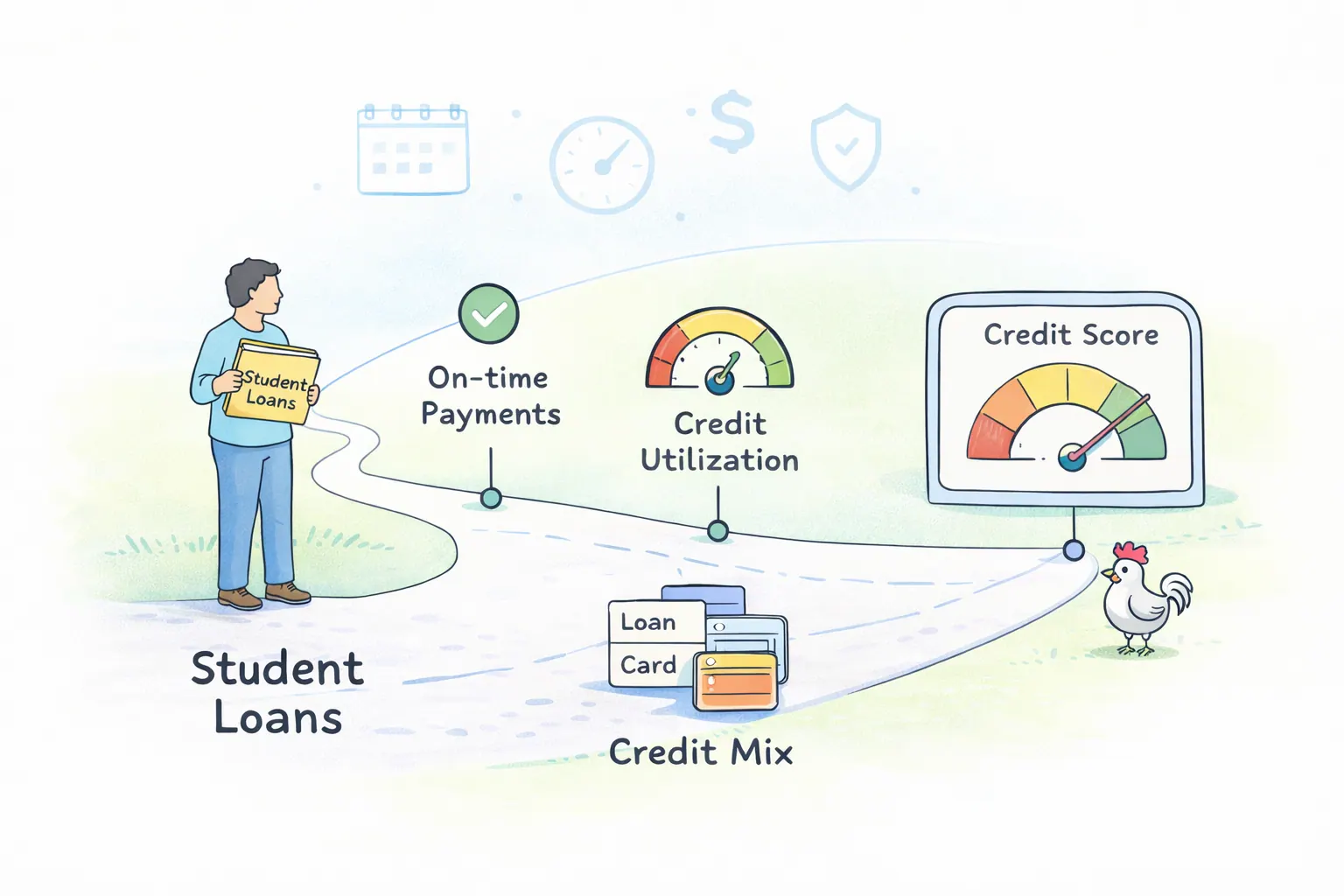
Student loan management supports several of these pillars at once, but the strongest outcomes come from balancing all of them together.
Frequently Asked Questions
-
What are the main types of student loan repayment plans?
- The main types for federal student loans include the Standard Repayment Plan (fixed payments over 10 years), Graduated Repayment Plan (payments increase over time, typically 10 years), and Income-Driven Repayment (IDR) Plans (payments based on income and family size, extended term).
-
How do student loans impact my credit score?
- Student loans significantly impact your credit score primarily through your payment history (35% of your score). On-time payments build a strong credit history, while missed or late payments can severely damage your score.
-
What are the consequences of missing a student loan payment?
- Missing a payment can lead to a late payment reported to credit bureaus after 30 days, causing a significant drop in your credit score. Persistent missed payments can lead to default, resulting in wage garnishment, tax refund offset, loss of federal aid eligibility, and severe long-term credit damage.
-
What is the difference between federal loan consolidation and private loan refinancing?
- Federal loan consolidation combines multiple federal loans into one with a weighted average interest rate, simplifying payments and potentially opening access to more IDR plans or PSLF. Refinancing (often with private lenders) involves taking a new loan to pay off existing ones, potentially securing a lower interest rate, but for federal loans, it means losing federal benefits like IDR.
-
When should I contact my student loan servicer?
- You should contact your loan servicer immediately if you anticipate any financial difficulty, foresee a missed payment, want to explore repayment options (like IDR, deferment, or forbearance), or believe there's an error in your loan information or credit report.
-
Can making extra payments on my student loans help my credit?
- While extra payments don't directly support your score beyond ensuring on-time payments, they can significantly reduce the total interest paid and shorten your repayment term, freeing up funds for other financial goals and improving your debt-to-income ratio, which indirectly supports your financial health.
-
How can I build a strong credit profile while managing student loans?
- Beyond diligent student loan payments, build a holistic credit profile by maintaining a mix of credit (installment and revolving), keeping credit card utilization low, building an emergency fund, and potentially using tools like secured credit cards or authorized user tradelines, which may help establish or strengthen your credit history in some profiles.
As you continue to build and fortify your financial nest, remember the sturdy twigs of your student loans are part of your story. Manage them with care, and they won't just represent an investment in your education; they'll become a strong, enduring part of your credit legacy, supporting your most ambitious flights to come.