Key Takeaways
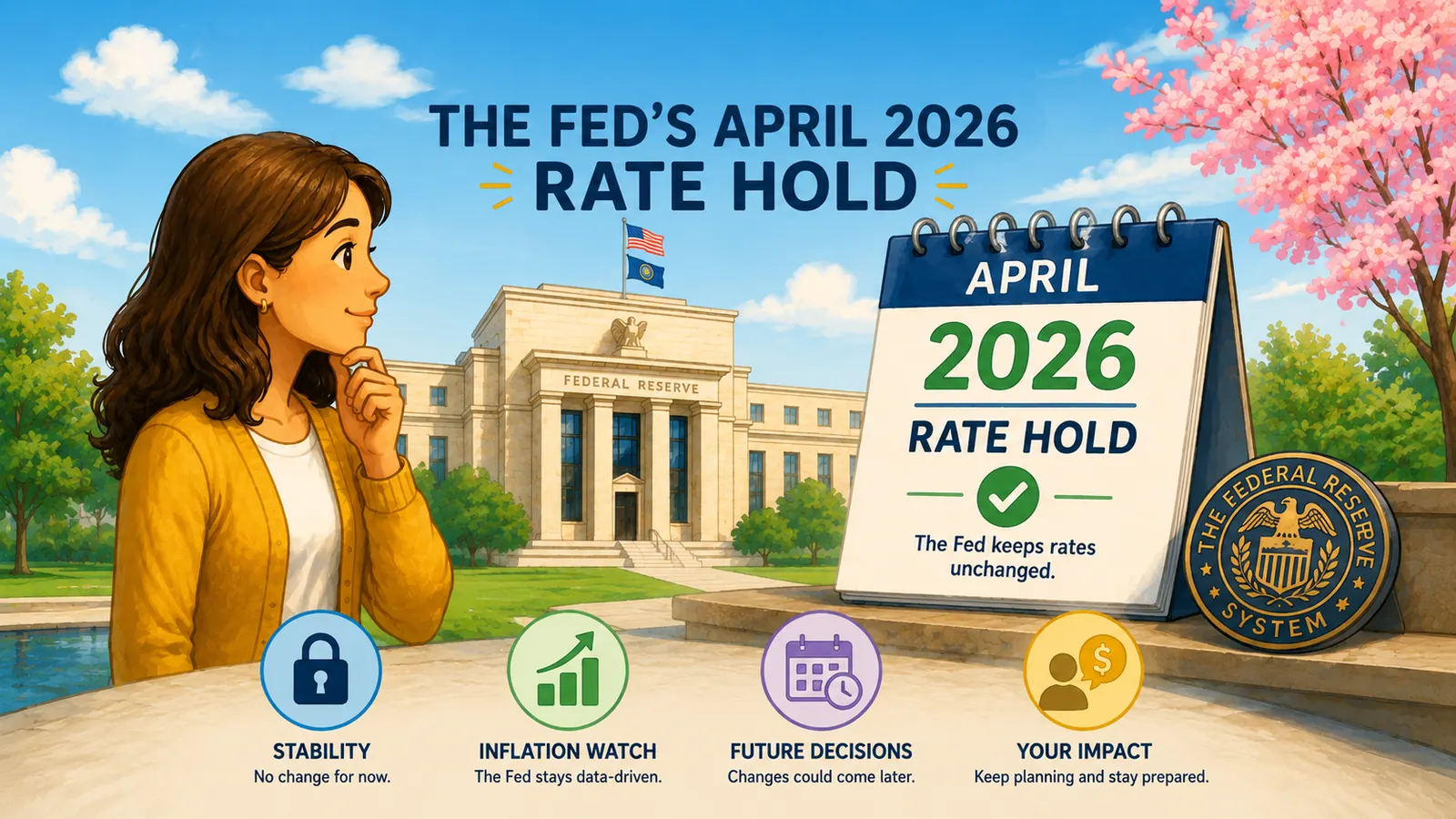
- The April 2026 Fed rate hold meant the benchmark Prime Rate remained steady, directly impacting the variable APRs on most credit cards.
- While your rate didn't change due to this specific action, understanding your card's Prime Rate + Margin structure is essential for long-term financial health.
- Even with stable rates, high revolving balances incur significant interest, often leading to a cycle of debt.
- A 30-day action plan focusing on reducing utilization and paying above the minimum can save you money and improve your credit profile.
- Your credit score and personal financial habits remain the biggest drivers of the margin component of your APR, regardless of Fed decisions.
- Consider this period of rate stability an opportunity to fortify your financial nest through proactive debt management and credit-building strategies.
The Calm Between Hikes
"A Fed rate hold means my credit card APR is locked in for the long haul."
A hold only freezes one component, the Prime Rate, until the next FOMC meeting. Your APR can still change if a promotional rate ends, if you go 60+ days late (penalty APR), or if you qualify for a new card with a lower margin. The hold is a window, not a guarantee.
The Stability of the Prime Rate
The Fed's decision to hold rates in April 2026 meant that, for a period, the benchmark Prime Rate, to which most variable-rate credit cards are tied, did not change. This provided a crucial moment of clarity for anyone carrying a revolving balance. It didn't mean your APR was 'frozen' forever, but it did mean that this specific economic lever wasn't pulling your rate higher or lower in the immediate aftermath of that meeting. It was a signal of stability, not stagnation.
Prime Rate
The benchmark short-term interest rate that most large U.S. banks charge their best corporate customers, which moves closely with the Fed's federal funds rate target.
Decoding Your Credit Card's APR
To understand why this 'hold' mattered, decode how your credit card APR is structured first. Most credit cards come with a variable APR, meaning the interest rate you pay isn't fixed; it can fluctuate. This rate is typically expressed as the U.S. Prime Rate (a benchmark interest rate set by banks, which closely follows the federal funds rate targeted by the Fed) plus a margin. For example, your card agreement might state "Prime Rate + 15%."
When the Fed holds the federal funds rate, the Prime Rate generally remains stable. So, if the Prime Rate was, say, 7.5% in April 2026, and your card's margin was 15%, your APR would hold steady at 22.5%. Had the Fed raised rates, the Prime Rate would likely have increased, pushing your APR up. If they had lowered rates, your APR would have dropped. The April 2026 hold simply meant that particular part of the equation remained constant.
What Actually Changed (Beyond the Rate Hold)
Even though a rate hold means your immediate APR doesn't move due to the Fed, it's not a green light to ignore your credit card debt. The stability simply provides a more predictable environment for a short while. It's an opportunity, not an excuse. What actually changed was the predictability of your interest payment for the short term, allowing you to breathe and strategize.
The Risks and Real Drivers of Your APR
Did the rate hold affect all credit products equally? Not quite. While credit cards tied to the Prime Rate saw stability, other loan products might react differently. For example, some adjustable-rate mortgages (ARMs) or home equity lines of credit (HELOCs) are tied to other indices or have different reset schedules. The focus here is specifically on variable-rate credit cards, where the impact of the Prime Rate is most direct and immediate for consumers carrying balances.
Real-Life Scenarios: How the Rate Hold Played Out
Three quick scenarios to see how the hold played out:
-
Nico, the Newcomer, and His First Secured Card: Nico got his first secured credit card six months before April 2026. His goal was simple: build a visible credit file and establish a payment history. With a modest credit limit of $300, he carefully used it for small purchases and paid it off in full every month. His APR was 25%. When the Fed held rates, Nico didn't see his APR change. This allowed him to continue focusing on his perfect payment history and keep his utilization at a strategic 1%. The stable rate environment meant he didn't have to worry about increased interest eating into his small payments, giving him peace of mind as he diligently built his credit nest, feather by feather. He knew that soon, he'd be ready for an unsecured card with a potentially lower APR, thanks to his responsible habits, regardless of what the Fed did next.
-
Riley, the Rebuilder, and Her Revolving Balance: Riley had faced some financial headwinds and was carrying a $4,500 balance across two cards, with APRs hovering around 26%. She was trying her best to pay more than the minimum but felt trapped by interest. The Fed's April 2026 rate hold was a small but significant relief. It meant her monthly interest payments wouldn't immediately increase, giving her a stable target. For Riley, this wasn't about celebrating lower rates, but about capitalizing on predictability. She used this stable period to double down on her debt repayment strategy, knowing exactly what her interest burden would be. This stability reinforced her determination to chip away at the principal, setting her up for future financial freedom.
-
Tiffany, the Time-Sensitive Planner, and a Big Purchase: Tiffany needed a new refrigerator but didn't have the cash on hand. She was considering opening a new credit card with a promotional 0% APR offer for 12 months, or using an existing card with a 20% APR. The Fed's rate hold reassured her that if she did use her existing card and couldn't pay it off within a billing cycle, her 20% APR wouldn't suddenly become 21% from the Prime Rate component. This predictability made her feel more confident in her budgeting and planning, knowing exactly what her borrowing costs would be if she carried a balance. However, she knew that even a stable 20% on a large purchase could quickly accumulate, pushing her to find a way to pay it off swiftly.
Nico (Newcomer)
Locked-in 25% APR on his secured card. Focuses on perfect payment history while the rate environment stays predictable.
Riley (Rebuilder)
Stable 26% APRs let her plan exact monthly interest costs and double down on principal payoff.
Tiffany (Planner)
Predictable 20% means she can model the cost of carrying a refrigerator purchase before deciding between options.
Your 30-Day Action Plan for Financial Fortification
The April 2026 rate hold offered a clear opportunity for borrowers to take proactive steps, without the immediate pressure of rising rates. If you were carrying a revolving balance, this period was an excellent time to shore up your financial nest. Here's a 30-day action plan that would have been prudent then, and remains relevant now:
Pull every credit card statement and write down the exact APR and balance per card
Rank cards by APR (highest first), this is the order you attack
Add at least $20-$100 above the minimum on the highest-APR card
Pay down balances 2-3 days before statement closing date for low utilization reporting
Check eligibility for a 0% balance-transfer offer if your score allows
Build a simple budget that earmarks the same dollar amount for repayment every month
Your Financial Fortification Plan
The Fed Rate Hold as an Opportunity
Disclosure
Some lenders and credit scoring models may filter out, discount, or weigh authorized user tradelines differently in their underwriting decisions. Results vary based on lender policies, the specific scoring model used, and your unique credit profile. An AU tradeline does not guarantee loan approval or any specific credit score outcome.
As the dust settled on the Fed's April 2026 decision, the financial landscape didn't drastically change overnight. Instead, it offered a brief, steady horizon. For your credit card APR, it meant no immediate shifts from the Prime Rate. This moment of calm was your signal to act. By understanding the mechanics of your APR, getting intentional about your payments, and diligently working to improve your credit profile, you could transform this period of stability into a springboard for genuine financial growth. Your nest, after all, is a testament to your effort and resilience, and every proactive step you take fortifies it against future economic shifts. Keep building, keep nurturing, and watch your financial future take flight.
Frequently Asked Questions
1. What did the Fed's April 2026 rate hold mean for credit card APRs?
- The Federal Reserve's decision to hold the federal funds rate in April 2026 meant that the benchmark U.S. Prime Rate, to which most variable-rate credit card APRs are tied, remained stable. This prevented immediate increases or decreases in the interest rates of existing credit card balances due to Fed action.
2. How does the Fed's rate decision affect my variable APR?
- Most variable credit card APRs are calculated as the U.S. Prime Rate plus a margin (e.g., Prime Rate + 15%). When the Fed holds its federal funds rate target, the Prime Rate typically remains unchanged, leading to a stable variable APR for your credit cards. Changes in the federal funds rate usually lead to corresponding changes in the Prime Rate, and thus your credit card APR.
3. Does a rate hold mean my credit card APR will never change?
- No, a rate hold only means the Prime Rate component of your variable APR isn't changing due to that specific Fed decision. Your APR can still change if a promotional rate expires, if you are more than 60 days late on payments (allowing the lender to apply a penalty APR), or if your creditworthiness improves significantly enough for you to qualify for a new card with a lower margin.
4. What is the 'margin' in my credit card APR?
- The 'margin' is the percentage point value that your lender adds to the Prime Rate to determine your specific variable APR. This margin is set based on your creditworthiness, credit score, and other risk factors at the time you open the account. It can vary significantly between individuals and credit card products.
5. What actions should I take if credit card rates are stable?
- Periods of stable credit card rates offer an ideal opportunity to focus on debt reduction. Key actions include: paying more than the minimum to tackle principal, prioritizing high-interest debt, strategically lowering your credit utilization ratio, exploring balance transfer offers, and maintaining a strict budget to free up funds for payments. These steps directly improve your financial health regardless of future Fed decisions.
6. How does my credit score influence my credit card APR?
- Your credit score is a primary factor in determining the 'margin' added to the Prime Rate on your credit card. A higher credit score typically results in a lower margin, leading to a lower overall APR. Conversely, a lower credit score usually means a higher margin and a higher APR, reflecting the lender's increased risk.