Key Takeaways
- Credit scoring models favor active, responsible credit use over absolute non-use.
- A 1-9% utilization ratio often scores better than 0%, indicating you can manage credit.
- Paying off your balance before the statement date can result in a 0% report, which isn't always optimal.
- Understand your statement closing date and current reporting practices to strategically manage your utilization.
- Combine strategic low utilization with on-time payments and diverse accounts for durable credit growth.
0% vs. 1% Utilization: The Subtle Mistake That Confuses Everyone
Imagine meticulously building a cozy, sturdy nest for your financial future. You've diligently gathered strong branches of on-time payments and woven in the soft lining of responsible credit habits. You've heard the whispers about credit utilization being a major feather in your cap, often likened to a dinner plate: don't load it too full. Most people understand that keeping your plate less than 30% full is the golden rule, but what if you're trying to achieve perfection? What if you're aiming for an empty plate, reporting 0% utilization month after month, only to find your credit score isn't quite soaring as high as you'd hoped? This is where a common, yet subtle, mistake confuses nearly everyone trying to optimize their credit score: the perplexing difference between 0% and 1% utilization.
The Myth of Perfect Zero
You might think showing absolutely no debt on your credit cards is the pinnacle of financial responsibility. It feels intuitive, doesn't it? An empty plate, no borrowing, pure virtue. But credit scoring models, those complex algorithms that decide your financial fate, don't always see it that way. They're not just looking for an absence of debt; they're looking for evidence of responsible credit management. And that's where the nuance between zero and just a tiny bit comes into play.
"Reporting 0% utilization every month is the cleanest, highest-scoring move."
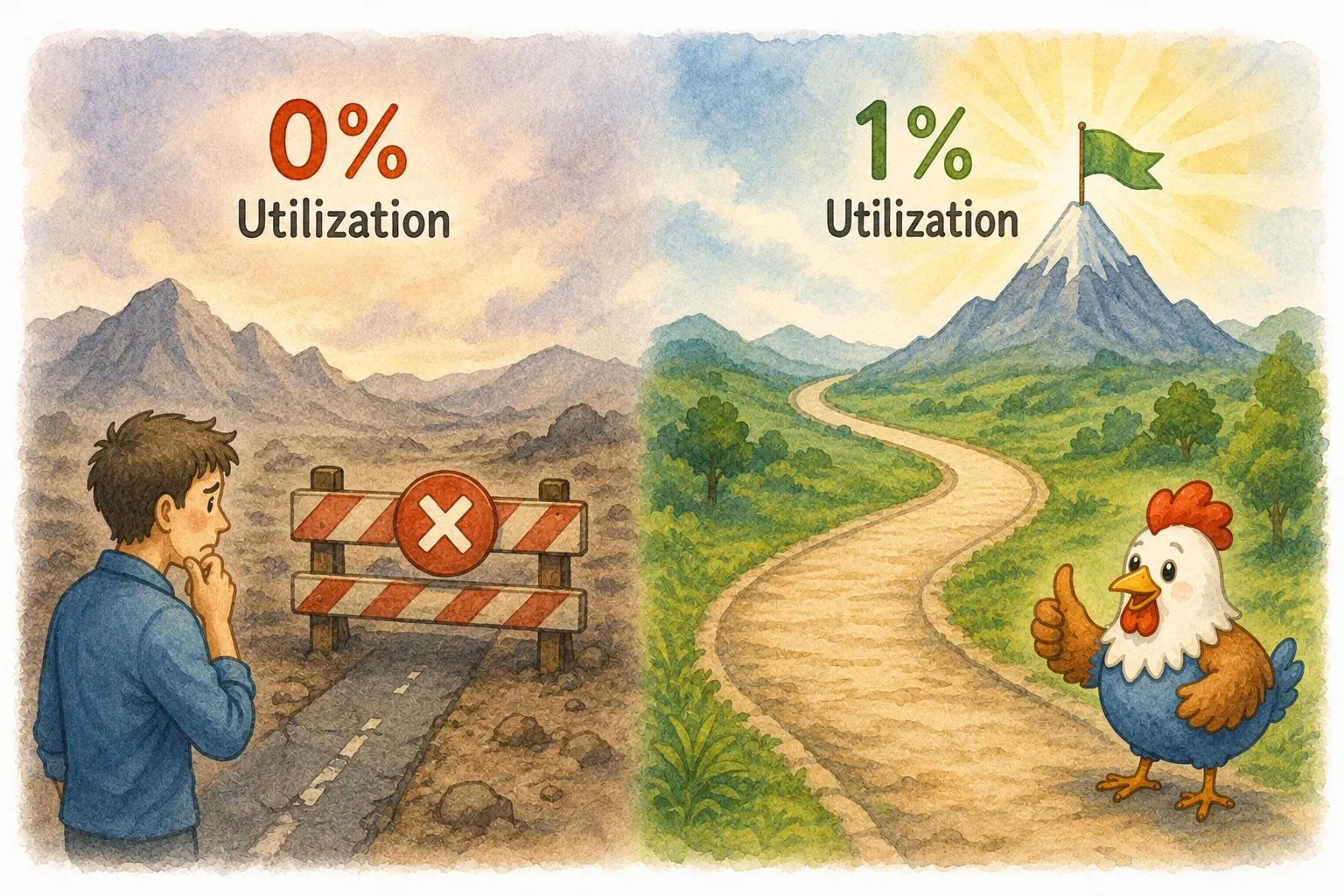
Scoring models reward visible, responsible activity. A flat 0% across all cards can look like dormancy, while a tiny 1-9% reported balance signals active, low-risk use that often scores a few points higher.
Why Zero Isn't Always Golden
The Sweet Spot of Low Utilization
Understanding Your Statement Closing Date
Statement Closing Date
The day your billing cycle ends and your card issuer takes the snapshot balance that gets reported to the credit bureaus.
Real-Life Scenarios: How This Plays Out
Let's look at a few common scenarios to see how this plays out:
-
Nico, the Newcomer: Nico recently got his first secured credit card and an authorized user tradeline to help build his file. He's incredibly careful, paying off every purchase the moment it posts, ensuring his statement always reports $0.00. He watches his score, expecting it to jump dramatically, but it inches up slowly. He's confused because he's doing 'everything right.' What Nico doesn't realize is that by constantly reporting 0% on his own card, he's not actively demonstrating his ability to manage a small, revolving balance. His tradeline helps by showing a longer history and higher limit, but his personal card isn't fully optimizing his utilization. The simple fix: let a small balance (say, $5-$10) report on his statement, then pay it off in full by the due date.
-
Riley, the Rebuilder: Riley is diligently recovering from some past financial mishaps. She has three credit cards with low limits. Determined to clean up her act, she never charges more than she can immediately pay off, often leading to 0% utilization reports. Her score is improving, but she hits a plateau. Like Nico, she's missing out on the slight boost that comes from showing just a hint of activity. By keeping one card with a tiny reported balance (e.g., $20 on a $2,000 limit = 1%), while keeping the others at zero, she could give her score that extra nudge. This staged approach helps identify the exact scoring factor moving her score up or down, allowing her to make targeted adjustments.
-
Sarah, the Strategic Homebuyer: Sarah needs to boost her score a few points for a better mortgage rate. She understands the difference. She plans to apply for her mortgage in two months. For the next two statement cycles, she charges a small, everyday expense (like a coffee) to one of her credit cards, allows that tiny balance to report (around 1-2% of her total credit limit), and then pays it off in full immediately. She repeats this for the second month. By following a staged plan and monitoring bureau updates before each next step, she may capture a few extra points on her utilization score, showing both active use and clean management at the moment lenders are looking. Sarah's broader prep work mirrors what we cover in preparing your credit for a mortgage.
Nico (Newcomer)
Lets a $5-$10 balance report on his secured card, then pays it in full by the due date.
Riley (Rebuilder)
Reports a 1% balance on one card while keeping the others at zero to break the plateau.
Sarah (Homebuyer)
Stages a 1-2% balance for two cycles before her mortgage application window.
How to Apply This Knowledge Strategically
- Let a 1-9% balance report on at least one card.
- Pay the reported balance in full before the due date.
- Find each statement closing date in your card portal.
- Wait one full reporting cycle before measuring impact.
- Carry a balance month to month to "show activity".
- Pay every charge instantly so every card reports $0.
- Time payments only to the due date, not the closing date.
- Apply for new credit during the cycle you are testing.
Find each card's statement closing date in your online portal
Make a small everyday purchase on one card mid-cycle
Let a 1-9% balance report on the statement closing date
Pay the balance in full before the payment due date
Watch the next bureau update for the new utilization figure
Mastering Your Credit Profile for Durability
Disclosure
Some lenders and credit scoring models may filter out, discount, or weigh authorized user tradelines differently in their underwriting decisions. Results vary based on lender policies, the specific scoring model used, and your unique credit profile. An AU tradeline does not guarantee loan approval or any specific credit score outcome.
Action Items
Frequently Asked Questions
1. Will reporting 0% utilization hurt my credit score?
- Not necessarily, but consistently reporting 0% can sometimes signal a lack of credit activity to scoring models, potentially preventing you from reaching your highest possible score. A small, reported balance is often preferred.
2. How do I know if my credit card company reports 0% utilization?
- Check your credit report through AnnualCreditReport.com or a credit monitoring app, and walk through how to pull your free annual credit reports. Look at the "credit utilization" for each card on your statement closing date.
3. What is the ideal credit utilization ratio to aim for?
- While keeping it below 30% is good, the sweet spot for optimal scoring often falls between 1% and 9%.
4. Should I intentionally carry a balance to show utilization?
- No, you should not carry a balance and pay interest. The goal is to have a small balance report on your statement closing date, which you then pay off in full by the due date to avoid interest.
5. How can I ensure a small balance is reported on my statement?
- Make a small purchase on your card and avoid paying it off until after the statement closing date, but before the payment due date.
6. Does paying off my credit card early hurt my credit score?
- Paying off your credit card before the statement closing date is what leads to a 0% utilization report. While it prevents interest, it might not be optimal for scoring if you do it every month for all cards. Paying before the due date is always recommended.
Your credit score reflects your financial habits. It is a living, breathing part of your financial nest, constantly evolving with your actions. Don't let the subtle difference between 0% and 1% utilization confuse you. Embrace the strategy of showing active, responsible use. Keep your payments on time, manage your utilization carefully (aiming for that sweet 1-9% spot), and continue to layer in durable credit-building habits. With this nuanced understanding, you're not just avoiding mistakes; you're actively cultivating a stronger, more impressive credit profile, ensuring your financial nest is built to last and ready to support your dreams.