Key Takeaways
- Closing an old card can harm your credit utilization ratio by reducing your total available credit.
- The average age of your accounts (AAoA) is a key factor, and closing old cards can eventually shorten your credit history.
- Think of old credit cards as strong, foundational branches of your credit nest; removing them can weaken its structure.
- Consider keeping old, no-fee cards active with small, recurring charges and auto-pay, or explore downgrading fee-based cards.
- Exceptions for closing include high annual fees on unused cards or if the card encourages irresponsible spending.
- Building new, positive credit history through personal accounts like secured cards and credit-builder loans is crucial for long-term health.
Why Closing Old Cards is Usually a Bad Idea for Your Credit Nest
- Keep no-fee cards open forever
- Set up small recurring charges
- Request a product change
- Use auto-pay to stay active
- Close your oldest account
- Let accounts go dormant
- Pay unnecessary annual fees
- Close multiple cards at once
The Double Whammy: Account Age and Credit Utilization
FICO Factor
Day 1
Account marked as closed
Year 1-5
Still visible, stops aging
Year 10
Removed from credit report
After
Average age may drop
Understanding Credit Utilization: Don't Shrink Your Plate!
When you close a credit card, you are essentially shrinking the size of your total plate. Even if your balance stays the same, your utilization ratio can go up because you have less available credit overall. For example, if you have two credit cards, each with a $5,000 limit, and you carry a $1,000 balance on one, your total available credit is $10,000. Your utilization is 10%. If you close the unused card, your total available credit drops to $5,000, and suddenly your utilization jumps to 20%, even though your spending has not changed.
"Closing old cards simplifies and helps your score."
Seasoned accounts anchor your average age and utilization.
Why?
Keeping old cards open preserves the depth of your profile and your total available credit.
When It's Okay to Prune: Exceptions to the Rule
Sometimes, trimming an old branch is the smarter choice for your credit nest. These exceptions usually fall into two main categories: high costs or harmful habits.
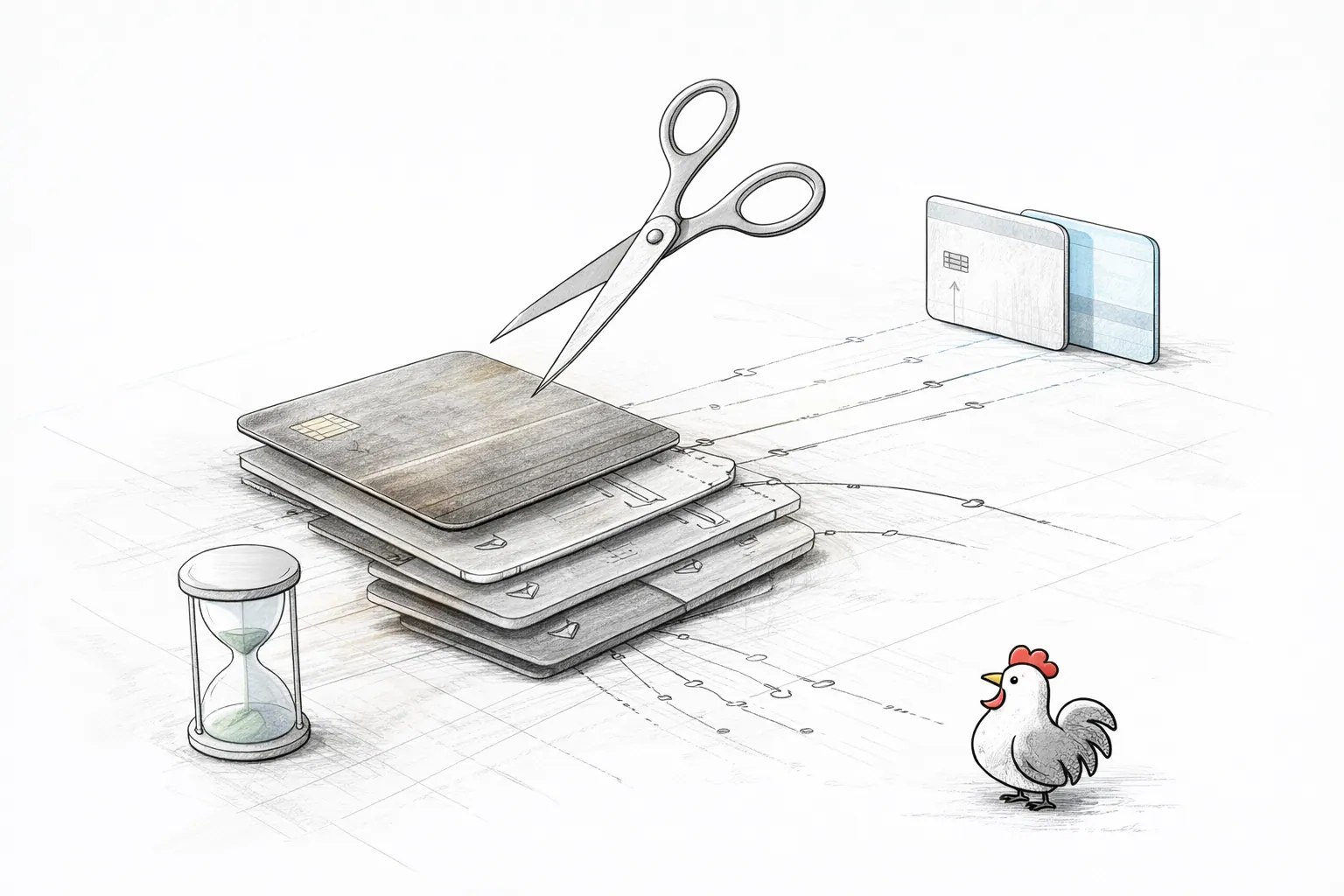
High Annual Fees: If you have an old credit card with a significant annual fee that you no longer use, keeping it open might not make financial sense. Before closing it outright, contact the issuer to see if you can request a product change.
Product Change
Switching an existing credit card to a different version within the same bank without closing the account.
Harmful Habits: If an old credit card is a constant temptation, leading you into debt, then closing it might be a necessary step for your financial well-being. Your mental and financial health matter more than a few credit score points. Removing that trigger can be a positive step toward healthier financial habits. This is about building a sustainable financial future, not just optimizing a number.
Product Change
Switch to no-fee version
Keep Open
Small recurring charge
Freeze Card
Prevent impulse use
Close Only If
High fee or triggers debt
Real-Life Nests: Scenarios for Every Credit Bird
Let's look at some scenarios to see how this plays out for different birds building their nests:
- Nico, the Newcomer, and His First Secured Card: Nico started his credit journey with a secured credit card three years ago. He now has a few unsecured cards and is thinking of closing the first one to simplify. Nico's best move is to keep that secured card open. It is likely his oldest account and it contributes significantly to his average account age. He can set up a tiny recurring charge, like a streaming service, and put it on auto-pay to keep it active without any effort. For tips on setting this up, see our guide on automating your payments.
- Riley, the Rebuilder, and Her Pre-Trouble Card: Riley is rebuilding her credit and has an old card with a $75 annual fee. It is her oldest account. If Riley calls her card issuer, she can ask for a product change to a no-annual-fee version. This preserves her 10-year credit history, which is invaluable for her rebuilding process, while eliminating the cost.
- Time-Sensitive Tracy, Preparing for a Mortgage: Tracy has an old store card she has not used in years. She is applying for a mortgage in six months and wonders if closing it would make her profile look cleaner. The safest bet for Tracy is to leave that card alone. Any potential negative impact on her score is not worth the risk right before a major financial application. Lenders scrutinize reports heavily, and consistency is key. For more on high-stakes credit, see Why Your Credit Score Matters.
How to Keep Old Cards Active (Without Overspending)
If you've decided to keep an old card open, you do not necessarily need to use it for daily purchases. Here are some strategies:
- Small, Recurring Charges: Set up a small subscription to be charged to the card monthly. Automate the payment for the full balance from your bank account.
- Occasional Use: Make a small purchase once every few months, such as a tank of gas, and pay it off immediately.
- Product Change: If an old card has an annual fee, ask the issuer about no-fee version options.
- Freezing the Card: If you are worried about overspending, physically or digitally freeze the card. This prevents impulsive use while keeping the account open.
Is there an annual fee you can't justify?
Building New Branches for a Stronger Credit Future
Your credit nest thrives on both time and thoughtful management. Those old, sturdy branches represent years of responsible behavior. While it can be tempting to simplify by removing them, the long-term health of your credit profile usually benefits from keeping them intact.
Action Plan for Your Old Cards
Discloure
Some lenders and credit scoring models may filter out, discount, or weigh authorized user tradelines differently in their underwriting decisions. Results vary based on lender policies, the specific scoring model used, and your unique credit profile. An AU tradeline does not guarantee loan approval or any specific credit score outcome.
Frequently Asked Questions
years on report
1. Does closing a credit card immediately affect my score?
- Yes, closing a credit card can immediately affect your credit score, primarily by increasing your credit utilization ratio. When you close a card, your total available credit decreases, which can make your current balances appear higher relative to your overall limit, even if your spending has not changed. The impact on your average account age is usually delayed.
2. How long do closed accounts stay on my credit report?
- Closed credit accounts in good standing typically remain on your report for up to 10 years from the date they were closed. Negative accounts generally remain for 7 years from the date of the delinquency.
3. What if my old card has a low credit limit?
- Even an old card with a low credit limit contributes positively to your average account age and your total available credit. While a small limit might not significantly impact your overall utilization, keeping it open helps maintain a longer credit history, which is a key scoring factor.
4. Is it better to keep an inactive credit card open?
- In most cases, yes, it is better to keep an inactive credit card open, especially if it has no annual fee and a long history. It helps maintain a higher total available credit and contributes to a longer average account age. To prevent the issuer from closing it due to inactivity, make a small purchase every few months.
5. Can closing a card improve my score if I have too many accounts?
- Generally, closing a card is unlikely to improve your score. The number of accounts is not a direct negative factor. Instead, lenders look at your ability to manage credit responsibly across all accounts. Closing an old card can often have a negative impact on your utilization and average account age.
6. What is a product change for a credit card?
- A product change allows you to switch your existing credit card to a different card offered by the same issuer, often without a new hard inquiry. This is useful for avoiding annual fees on cards you no longer use, as it allows you to retain your account history while transitioning to a no-annual-fee option.