Key Takeaways
- AutoPay helps ensure consistent, on-time payments, positively impacting 35% of your FICO score.
- It acts like an automatic feeder for your credit, ensuring your accounts are always nourished.
- While authorized user (AU) tradelines offer a fast visibility boost, building your own payment history through AutoPay on personal accounts is essential for durable credit strength.
- Always set AutoPay to cover at least the minimum, or ideally, the full statement balance to manage credit utilization.
- Regularly review your AutoPay settings and account balances to prevent overdrafts or missed payments due to insufficient funds.
The Foundation of Your Roost: Payment History
Payment History
The record of how reliably you make payments on your debts, accounting for 35% of your FICO score.
AutoPay: Your Trusty, Automatic Feeder
This is where AutoPay swoops in as your most reliable ally. Picture it as an automatic feeder for your credit roost. Once set up, it consistently delivers the necessary nourishment (your payments) on schedule, without you needing to remember each specific due date. This simple automation can be a game-changer for anyone looking to build or rebuild their credit. It eliminates the risk of human error. that forgotten due date, that bill lost in the shuffle, or that busy week where finances slipped your mind.
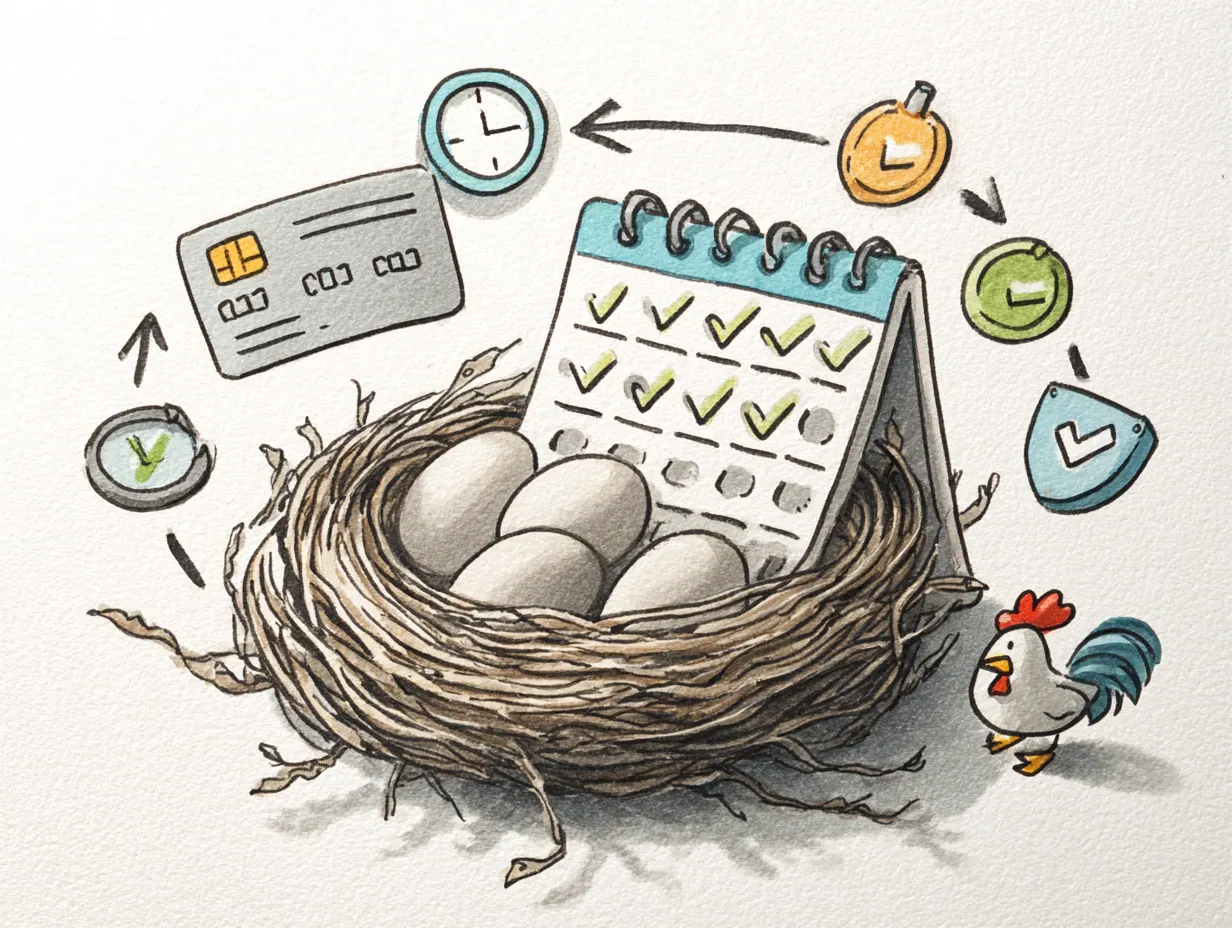
Hatching Your AutoPay Strategy: A Step-by-Step Guide
Setting up AutoPay is usually a straightforward process, but it pays to be diligent. Here’s how to do it and what to consider:
Log In to Account
Navigate to Payments
Choose Amount
Select Date
Link Bank Account
Review & Confirm
- Log In to Your Account: Access your online portal for your credit card, loan, or utility provider.
- Navigate to Payment Settings: Look for sections like 'Payments,' 'Bill Pay,' 'Account Management,' or 'AutoPay Settings.'
- Choose Your Payment Amount: Most services offer options:
- Minimum Payment Due: This is the bare minimum to avoid late fees and negative marks on your credit. While it keeps your payment history pristine, it won't help much with credit utilization if you carry a balance.
- Statement Balance: This is generally the best option for credit building. It ensures you pay off your entire balance each month, avoiding interest charges and keeping your credit utilization at its lowest.
- Custom Amount: You might choose a specific amount higher than the minimum but less than the full balance, often used for budgeting or strategic debt reduction. Always ensure this covers at least the minimum due.
- Select Your Payment Date: Often, you can choose to have the payment processed on the due date, or a few days before. Opting for a few days prior can provide a buffer against any unexpected delays.
- Link Your Bank Account: You'll need your bank's routing number and your account number. Double-check these for accuracy.
- Review and Confirm: Before finalizing, carefully review all the details. Ensure the amount, date, and linked account are correct.
Once activated, you’ll typically receive an email confirmation. Mark your calendar for a monthly check-in to ensure payments are processing correctly and your bank account has sufficient funds.
Your Nest, Your Responsibility: Why Personal Accounts Matter
While authorized user (AU) tradelines can add early credit visibility for some consumers, the enduring strength of your financial roost ultimately comes from your own accounts and your own responsible habits. Imagine an AU tradeline as a strong branch added to your nest, providing immediate support. It’s incredibly helpful, but the core of the nest, the one you painstakingly weave yourself, is what truly makes it durable and uniquely yours.
Disclosure: Some lenders and credit scoring models may filter out, discount, or weigh authorized user tradelines differently in their underwriting decisions. Results vary based on lender policies, the specific scoring model used, and your unique credit profile. An AU tradeline does not guarantee loan approval or any specific credit score outcome.
Beyond On-Time: Optimizing Your AutoPay for Utilization
Here are some real-life scenarios:
- Nico, the Newcomer: Nico just got his first secured credit card. He immediately sets up AutoPay to cover the full statement balance each month. By doing this, he's both building a perfect payment history and keeping his credit utilization at 0%, demonstrating exceptional financial management from the start. His credit roost is built on solid, consistent foundations.
- Riley, the Rebuilder: Riley previously struggled with missed payments. After setting up autopay, she used a goodwill letter to request removal of the old late marks. To break the cycle, he set up AutoPay for the minimum payment on his existing credit card and a new credit-builder loan. After a few months of consistently on-time payments, he adjusted his credit card AutoPay to pay the full statement balance, seeing his score stabilize and begin to climb as his utilization dropped.
- Tracy, Time-Sensitive: Tracy needed proof of credit history quickly for an apartment application. She secured an authorized user tradeline, and for her first personal utility bill that reports payments, she set up AutoPay. This combination gave her both fast visibility and the beginning of a personal, positive payment record, proving she's a reliable tenant.
Avoiding the Storms: Potential Pitfalls of AutoPay
While AutoPay is a fantastic tool, it's not entirely hands-off. You still need to be mindful of a few potential traps:
AutoPay Best Practices
- Check bank balance before payment dates
- Update payment info when bank details change
- Review monthly statements for accuracy
- Set calendar reminders for monthly check-ins
- Keep a buffer in your linked account
- Assume payments always process correctly
- Forget to update expired card info
- Ignore unexpected balance increases
- Let your account run too low before payment dates
- Skip reviewing your statements each month
- Insufficient Funds (Overdrafts): This is the biggest pitfall. If a payment is automatically attempted but there isn't enough money in your linked bank account, you could incur overdraft fees from your bank and a late payment fee from your lender. Worse, a failed AutoPay could still result in a reported late payment to the credit bureaus. Regularly check your bank account balance, especially before large AutoPay dates.
- Forgetting to Update Payment Info: If your bank account number changes, your card expires, or your bank merges, you must update your AutoPay settings. Otherwise, payments will fail.
- Over-Reliance Without Review: AutoPay is a convenience, not a substitute for financial oversight. Always review your monthly statements for accuracy, unauthorized charges, or unexpected balance increases. Just because it's automatic doesn't mean you can completely forget about it.
By staying vigilant and performing quick monthly checks, you can harness the power of AutoPay while avoiding these potential storms.
Your Roost, Stronger and Steadfast
AutoPay is one of the most impactful tools in your credit-building toolkit, especially for solidifying that all-important payment history. For newcomers and those looking to rebound, it provides a consistent, reliable mechanism to demonstrate financial responsibility to lenders. Remember, while authorized user tradelines offer a unique speed advantage in establishing initial credit visibility, the true, durable strength of your credit profile blossoms from managing your own accounts diligently.
Month 1
Enable AutoPay on all accounts with full statement balance
Month 3
Verify payments processed; check utilization ratio
Month 6
See consistent payment history reflected in score
Month 12
Strong payment history established; consider new credit
AutoPay on your own credit accounts, paired with a commitment to keep utilization low, is how you build a financial roost that stands strong against any storm. It's a key habit that reinforces every other positive credit action you take. Don't underestimate the power of automation in achieving financial consistency.
Action Items
- Ready to see your credit file take flight? Explore how authorized-user tradelines can provide an early path to credit visibility.
- For durable, long-term credit strength, consider building through your own accounts with secured cards, credit-builder loans, and rent reporting.
Frequently Asked Questions
1. What is AutoPay and why is it important for credit building?
- AutoPay is a service that automatically deducts your bill payment from a linked bank account on the due date. It's crucial for credit building because it ensures consistent, on-time payments, which account for 35% of your credit score, virtually eliminating missed payments due to forgetfulness.
2. How does AutoPay impact my credit score?
- By helping ensure on-time payments, AutoPay directly contributes to a positive payment history, the largest factor in your FICO score. If set to pay the full statement balance, it also helps keep your credit utilization low, which positively impacts another significant portion of your score.
3. What is the best amount to set for AutoPay?
- While setting AutoPay to cover at least the minimum payment due avoids late fees, the best option for credit building and avoiding interest is to set it for the full statement balance. This keeps your credit utilization at its lowest and maximizes positive impact.
4. Can I still use authorized user tradelines if I'm using AutoPay on my personal accounts?
- Absolutely. Authorized user (AU) tradelines may add early credit visibility, while AutoPay on your personal accounts builds your direct payment history and long-term credit strength. They are complementary strategies for a robust credit profile.
5. What are the potential risks or pitfalls of using AutoPay?
- The biggest risk is insufficient funds in your linked bank account, which can lead to overdraft fees and a failed payment reported as late. Other pitfalls include forgetting to update payment information when bank details change, or over-relying on automation without reviewing monthly statements.
6. How often should I review my AutoPay settings and account balances?
- It's highly recommended to review your AutoPay settings and check your linked bank account balances at least monthly, especially before scheduled payment dates. This vigilance helps prevent overdrafts, catches errors, and ensures your payments are always successful.
Just as a diligent bird constantly tends to its nest, adding strong twigs and ensuring its young are fed, consistent financial habits are crucial for your credit health. Setting up AutoPay is like adding a sturdy, self-replenishing feeder to your financial roost, ensuring your credit history is always nourished, always growing stronger. Embrace this simple yet powerful habit, and watch your credit profile soar towards new heights of reliability and trust. Your journey to a powerful credit score starts with these consistent, steady beats of responsible financial behavior.