Key Takeaways
- Access your free credit reports annually from AnnualCreditReport.com to inspect all three bureaus.
- Methodically review personal details, tradelines (accounts), payment history, credit limits, inquiries, and public records.
- Prioritize identifying inaccuracies, outdated information, or unfamiliar accounts that could signal identity theft.
- Understand the implications of each section, from payment patterns to hard inquiries, on your overall credit health.
- Know when to dispute errors with credit bureaus and when to simply monitor changes for ongoing financial stability.
Laying Out Your Blueprint: Getting Started with Your Report
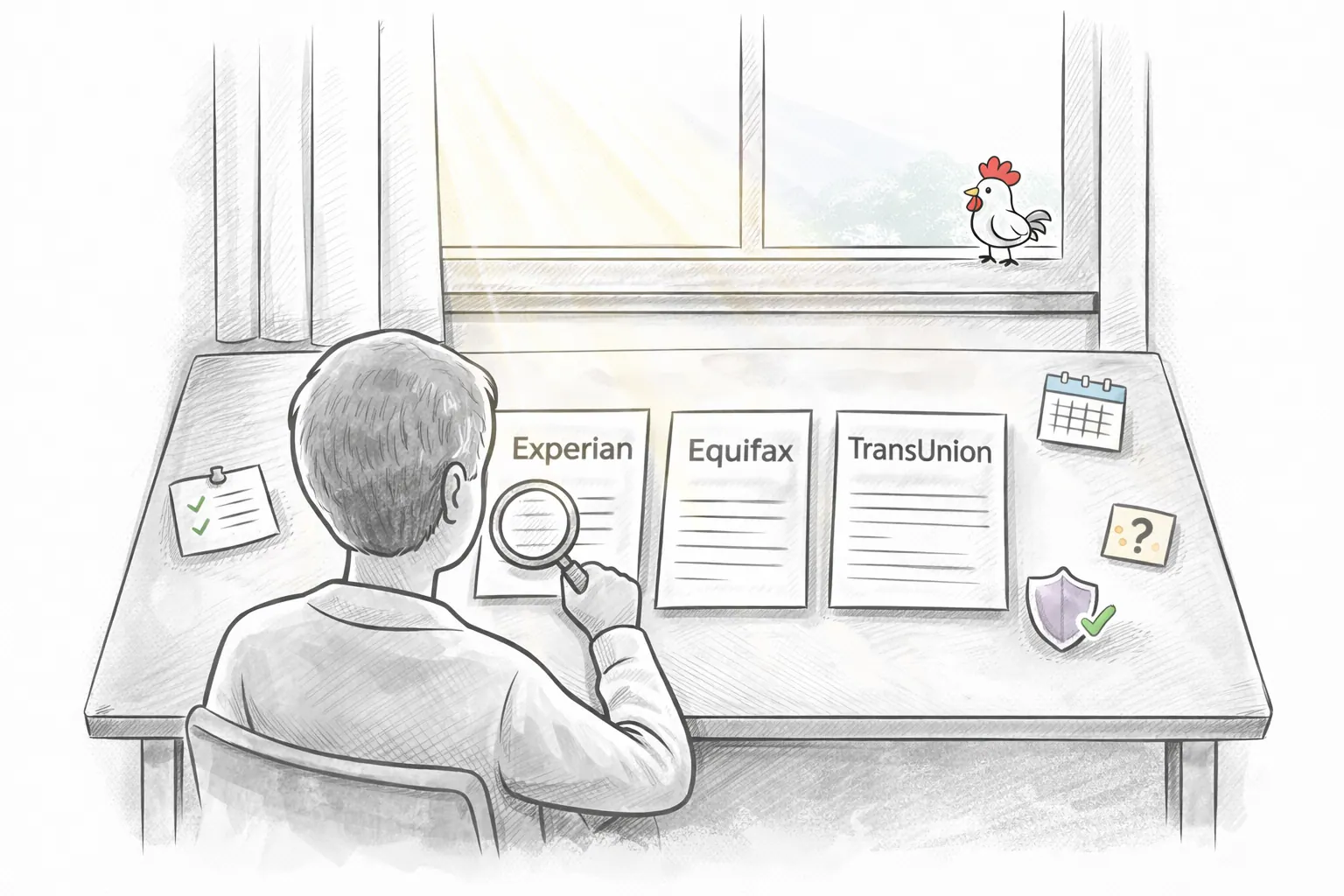
Personal Information
This is where your report introduces you. It typically includes:
- Your Name: Your full legal name, and any previous names or aliases.
- Current and Former Addresses: A list of where you've lived.
- Date of Birth: Your birthdate.
- Social Security Number (SSN): Often masked for security, but crucial for identification.
- Employment Information: Your current and sometimes past employers.
What to look for: This section is your first line of defense against identity theft. Check for any incorrect spellings of your name, addresses where you've never lived, or employers you've never worked for. A mismatch here could indicate a simple clerical error or, more alarmingly, that someone else is using your identity to open accounts. It’s like checking if the name on your nest’s deed truly belongs to you.
Use this quick checklist whenever you open a new bureau report so you can catch identity mismatches early:
Name Consistency
Verify legal name, aliases, and spelling across all three bureaus.
Address History
Flag addresses you never used or old addresses that should be inactive.
SSN Accuracy
Confirm masked SSN alignment and watch for mismatched identifiers.
Employment Data
Check employer names for obvious errors or unfamiliar entries.
Decoding Your Tradelines: Account Information Unveiled
- Creditor Name: The name of the bank, lender, or company that issued the credit (e.g., Chase, Wells Fargo, student loan servicer).
- Account Number: Usually partially masked for security.
- Account Type: (e.g., revolving, installment, open), credit card, auto loan, mortgage, student loan.
- Date Opened: When you first established the account. This contributes to your 'length of credit history,' a significant factor in your scores.
- Credit Limit or Loan Amount: For revolving accounts like credit cards, this is your maximum spending limit. For installment loans, it's the original loan amount.
- Current Balance: How much you currently owe on the account.
- Payment Status/History: This is critical. It shows a month-by-month record of your payments, indicating whether they were on time, 30 days late, 60 days late, etc. A consistent history of on-time payments is the strongest twig in your nest.
- Date of Last Activity: The most recent action on the account.
If you're auditing multiple accounts quickly, this summary table keeps your review sequence consistent:
Tradeline Review Sequence
| Field | Why It Matters | Common Red Flag |
|---|---|---|
| Account Type | Affects profile mix and lender interpretation | Account mislabeled as revolving or installment |
| Balance/Limit | Directly impacts utilization | Balance too high or limit too low versus statements |
| Payment Status | Strongest score influence over time | On-time payment reported as late |
| Opened/Closed Dates | Influences age and timeline context | Incorrect open date or account still marked open |
Once this baseline is clear, you can dive into each tradeline line by line with fewer misses.
Tradeline
A credit account listed on your credit report, detailing your borrowing and repayment habits.
Peeking into Your Nest: Understanding Credit Inquiries
This section lists everyone who has requested to view your credit report. There are two main types of inquiries, and understanding the difference is key:
- Hard Inquiries: These occur when you apply for new credit (e.g., a credit card, mortgage, car loan). Hard inquiries can have a small, temporary negative impact on your credit score and typically remain on your report for two years. Lenders see these as you seeking more credit, which can sometimes be a red flag if there are too many in a short period. It’s like other birds peeking into your nest to see if you’re collecting new materials.
- Soft Inquiries: These occur when you check your own credit report, or when a lender pre-approves you for an offer, or for identity verification purposes. Soft inquiries do not affect your credit score and are only visible to you.
When you find a hard inquiry you don’t remember, use a simple decision path before taking action:
Do you recognize this hard inquiry?
This keeps your response consistent and reduces hesitation when timing matters.
Consumer Statement or Fraud Alert (Optional)
This isn't always present, but it's a powerful tool you can use. If you've been a victim of identity theft, or if you've disputed an item on your report and it hasn't been fully resolved, you can add a brief statement to your report explaining your side of the story or noting a fraud alert. This statement will be seen by anyone who pulls your credit report.
Spotting the Loose Twigs: Identifying Mismatches and Aging Issues
Once you’ve gone through each section, it’s time to put on your detective hat. Here are some key things to focus on:
- Mismatches in Personal Information: As mentioned, incorrect names, addresses, or employers are red flags. Make sure every detail is precisely yours.
- Accounts You Don’t Recognize: This is critical. An unfamiliar credit card, loan, or even a collection account could be a sign of identity theft. Act immediately if you find one.
- Incorrect Payment Status: A payment you made on time incorrectly reported as late is a significant error. Each late payment costs you points.
- Inaccurate Balances or Credit Limits: If your credit card balance is reported higher than it should be, or your credit limit lower, it can negatively impact your utilization ratio (how much credit you're using versus how much you have available), which is a major factor in your score. Use the 30% utilization rule as a practical benchmark while auditing this.
- Outdated Information: Negative information, like late payments or collection accounts, generally should fall off your report after seven years (bankruptcies up to 10). If you see items older than this, they should be removed.
- Duplicate Accounts: Sometimes, an account might be listed twice, especially if a debt was sold to a new collection agency. This can sometimes look worse than it is, but it's worth addressing.
- Verify dates and ownership details before filing a dispute.
- Save screenshots and statements for every discrepancy you track.
- Check all three bureaus, not just one report.
- Ignore unfamiliar accounts while waiting for your next annual pull.
- Assume a paid collection is always updated automatically.
- Submit disputes without clear supporting evidence.
Here are some real-life scenarios:
- Nico, the Newcomer: Nico, fresh out of college, wanted to get his first apartment but was told his credit file was "thin." He pulled his free credit reports and noticed only his student loan was showing, and surprisingly, an old cell phone bill he thought he paid off years ago was listed as "in collections." He knew he settled that bill. By understanding his report, Nico realized he needed to dispute the cell phone collection. He also saw how adding a responsible tradeline, like being an authorized user on a parent's long-standing credit card (one possible early path to credit visibility), or getting a secured card, would add the necessary "twigs" to make his nest visible to landlords.
- Riley, the Rebuilder: Riley was working hard to re-establish her credit after a tough few years. She was meticulously paying all her current bills on time and kept her credit card utilization low. When she pulled her credit report, she noticed an old medical bill from five years ago that she had paid, was still showing as unpaid in collections. This was significantly dragging down her score. Recognizing this discrepancy on her report, Riley immediately gathered her proof of payment and initiated a dispute. This single corrected item may make a noticeable difference in stabilizing her credit nest.
When to Act: Disputing Errors and Monitoring Your Report
- Gather Evidence: Collect any documentation that proves the error (e.g., payment receipts, canceled checks, court documents).
- Contact the Bureau: Write a dispute letter to the credit bureau(s) reporting the incorrect information. Clearly state what you believe is wrong and why, and include copies of your evidence.
- Contact the Creditor: It's also wise to send a dispute letter directly to the creditor or collection agency that reported the information.
Document the issue
Capture account details, dates, and supporting files.
Submit bureau dispute
File clearly with the bureau that is reporting the error.
Notify furnisher
Send a matching dispute to the lender or collector.
Track outcome
Re-check all bureaus after investigation windows close.
The bureaus have 30-45 days to investigate your claim. If they can't verify the information, they must remove it. If you suspect identity theft, in addition to disputing, consider placing a fraud alert or a credit freeze on your files.
When to Monitor: Sometimes, there isn't an error, but rather an accurate (though perhaps undesirable) piece of information. For example, a legitimate late payment or a valid hard inquiry. In these cases, your job is to monitor. Keep making on-time payments, keep utilization low, and allow time for positive habits to build a stronger history. Remember, negative items do age off your report, so patience and consistent positive action are key.
Your Nest, Your Control: Building Sustainable Credit Health
Regularly reading and understanding your credit report is not a one-time task; it's an ongoing practice for maintaining your financial health. It’s the ultimate financial health check-up, allowing you to catch issues early and celebrate progress. By knowing what’s on your report, you're better equipped to make informed financial decisions and protect yourself from fraud. You’re taking active control of your financial nest.
While understanding your report is fundamental, remember that building a robust credit profile often requires strategic moves. For many newcomers and rebuilders, securing initial credit visibility is the first hurdle. Authorized user (AU) tradelines can be one possible path to establishing this visibility, especially when tied to a well-aged, responsibly managed account. This can be one branch you use while you build durable credit history of your own.
However, true, lasting strength for your nest comes from adding your own accounts and habits. Supplementing AU tradelines with durable builders like secured credit cards, credit-builder loans, and consistent rent reporting ensures your nest is built on a foundation of your own responsible actions. These tools, combined with low utilization and on-time payments, create a resilient financial future.
Disclosure
Some lenders and credit scoring models may filter out, discount, or weigh authorized user tradelines differently in their underwriting decisions. Results vary based on lender policies, the specific scoring model used, and your unique credit profile. An AU tradeline does not guarantee loan approval or any specific credit score outcome.
Ready to take the next step in building or rebuilding your credit?
Action Items
Frequently Asked Questions
-
How often should I check my credit report?
- You are entitled to one free credit report from each of the three major bureaus (Equifax, Experian, TransUnion) annually via AnnualCreditReport.com. It's wise to check them regularly, at least once a year, to monitor for accuracy and potential fraud.
-
What is a "tradeline" and why is it important?
- A tradeline is any account that appears on your credit report, such as a credit card, auto loan, or mortgage. These are important because they detail your borrowing and repayment history, significantly influencing your credit score and demonstrating your financial responsibility to lenders.
-
What's the difference between a hard inquiry and a soft inquiry?
- A hard inquiry occurs when you apply for new credit and can temporarily lower your credit score. A soft inquiry happens when you check your own credit or when lenders pre-approve you for offers; it does not affect your score.
-
How long do negative items like bankruptcies or collections stay on my report?
- Most negative items, such as late payments or collection accounts, remain on your report for about seven years from the date of original delinquency. Bankruptcies can stay for 7 to 10 years, depending on the type.
-
What should I do if I find an error on my credit report?
- If you find an error, gather evidence to support your claim (e.g., payment receipts) and then dispute the information directly with the credit bureau(s) reporting it. It's also a good idea to contact the creditor or collection agency involved.
-
Can old, accurate negative information be removed from my report?
- Accurate negative information generally cannot be removed before its statutory reporting period ends (typically seven years for most items, 7-10 for bankruptcies). Your best course of action is to ensure all current accounts are paid on time and keep utilization low, allowing positive history to outweigh the old negative items.
Just as a diligent bird regularly inspects its nest for wear and tear, you must regularly inspect your credit report. It’s not just about identifying problems; it’s about understanding the narrative of your financial journey and ensuring it reflects your efforts accurately. By mastering the art of reading your credit report, you gain the power to protect your financial reputation, make smarter borrowing decisions, and ultimately, build the strongest, most resilient financial nest possible for yourself and your future. Keep checking, keep building, and keep soaring towards your financial goals.