Key Takeaways
- Always verify debt ownership, amount accuracy, and reporting dates before taking action.
- A charge-off is reported by the original creditor, while a collection is handled by a third-party collector or debt buyer.
- Never negotiate or make payment commitments without getting clear written terms first.
- Know your statute of limitations rules before contacting collectors about older debt.
- You recover faster when you resolve negatives and build positive credit habits at the same time.
Understanding the Core: Charge-Offs vs. Collections
You have probably seen these terms in account summaries, lender letters, or credit monitoring alerts. In everyday language, they often get blended together, but there are practical differences that matter.
A charge-off usually appears after extended nonpayment, commonly around 180 days on many revolving accounts. The creditor moves the account into a loss category for accounting. That accounting step does not erase the balance. The debt may still be collected by the original creditor or sold.
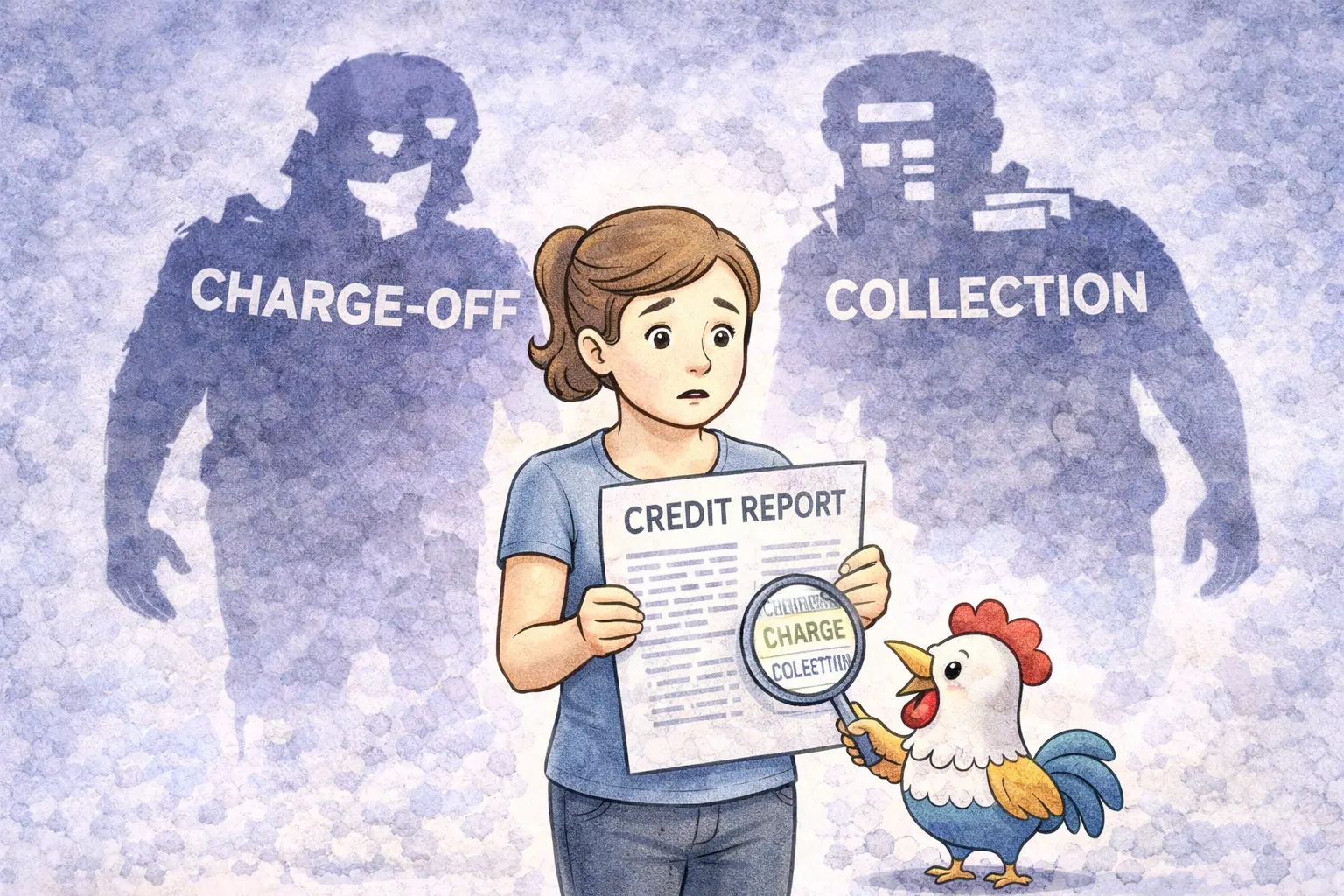
A collection indicates active collection efforts by a third party. That third party might be an agency assigned by the creditor, or a company that purchased the debt. Ownership and authority can vary, so your first task is always verification.
Both entries can affect approval odds and pricing. Both can remain visible for years from the original delinquency date under standard reporting rules. What differs is your action path: whom you contact, what records you request, and how you negotiate reporting outcomes.
The Five Costly Mistakes That Keep Your Credit Nest Shaky
When people feel pressure to fix credit fast, they often optimize for speed instead of control. That is where expensive mistakes happen.
The five mistakes below show up again and again. They are not dramatic legal edge cases. They are common everyday errors in sequencing, documentation, and follow-through.
Mistake 1: Not Verifying the Debt First
This is the most common opening mistake. A letter arrives or a collector calls. You feel urgency, embarrassment, or fear. You want it gone now. So you either ignore it completely or jump to payment before checking facts. Both paths can create problems.
Scenario: Riley receives a call from a collector claiming she owes $800 on an old card. She barely remembers the account, but she offers payment anyway just to end the stress. She pays. Later she learns the reporting details were inconsistent across bureaus, the terms were never documented, and the account status did not update in the way she expected.
This first step protects you from paying incorrect balances, paying the wrong party, or weakening your position before you understand your options.
How Timing and Strategy Work Together
These two mistakes usually travel together. People either ignore legal timing and negotiate too early, or negotiate too quickly without a written objective.
Mistake 2: Ignoring the Statute of Limitations (SOL)
Many people confuse two clocks:
- Credit reporting duration.
- Statute of limitations for legal enforcement.
They are not the same thing. Reporting rules often allow negative items to remain for years. SOL rules, by contrast, concern the time window for legal action and vary by state and debt type.
Scenario: Nico sees an old charged-off account and calls to offer a small payment before checking state SOL rules. He thinks he is reducing risk. Instead, he loses leverage because he acted without understanding timing.
Collectors may still attempt collection beyond certain legal windows depending on jurisdiction, but your rights and risk profile can differ significantly based on timing. Knowing this first keeps you from making avoidable decisions under pressure.
Mistake 3: Negotiating Without a Clear Strategy (and Getting Nothing in Writing)
Even after validation, many people negotiate informally and hope the account will look better later. That is where expectations and outcomes diverge.
Scenario: Riley verifies an old medical collection and agrees by phone to settle at 50%. She pays. Months later, the tradeline remains as paid collection because deletion was never committed in writing.
Keep records for every step: letters, account references, dates, names, settlement terms, payment proof, and follow-up confirmations.
Mistake 4: Disputing Incorrect Information Blindly (or Too Soon)
Dispute rights are important, but broad unstructured disputes often fail. A vague challenge without evidence can waste cycles and reduce your leverage for the next action.
Scenario: Nico disputes a charge-off as not his. Bureau investigation verifies account identity details and rejects the claim. The real issue was an incorrect date field, not account ownership.
The Fix: Dispute the exact inaccuracy with supporting documentation. If the balance is wrong, challenge the balance with records. If dates are wrong, challenge date fields with evidence. If ownership is wrong, challenge ownership with identity and account records.
Order matters. In some situations, negotiation first can be better. In others, correcting factual reporting errors first improves settlement posture. What hurts most is random action without a strategy tree.
Mistake 5: Neglecting Your Overall Credit Profile While Dealing with Negatives
This mistake is less visible but very expensive. People focus so much on removing one negative item that they forget active scoring behavior still matters every month.
Scenario: Riley spends months resolving one collection but lets card utilization run high and misses a payment elsewhere. Even if one negative improves, new negative behavior offsets gains.
The Fix: Keep recovery two-track:
- Resolve negative items with documentation.
- Protect active account behavior at the same time.
Disclosure
Some lenders and credit scoring models may filter out, discount, or weigh authorized user tradelines differently in underwriting decisions. Results vary by lender policy, scoring model, and credit profile. An AU tradeline does not guarantee loan approval or a specific score outcome.
Your Action Plan: Untangling Your Credit Nest
A methodical sequence reduces mistakes and improves odds of measurable progress.
Step 1
Pull all three reports and validate owner, amount, and dates.
Step 2
Check legal timing and choose dispute-first or negotiate-first path.
Step 3
Get written terms before any payment commitment.
Step 4
Track updates monthly and keep active-account habits stable.
Here is a practical sequence you can follow:
- Verify first: Compare all bureau entries and validate debt authority.
- Check timing rules: Review state SOL context for the debt type.
- Choose a strategy: Dispute precise inaccuracies and negotiate with clear written targets.
- Document everything: Keep all records in one folder with dates and reference numbers.
- Protect active accounts: Stay current and control utilization while cleanup is in process.
- Re-check reports monthly: Confirm bureau updates match negotiated and disputed outcomes.
Also set expectations correctly. Credit cleanup usually moves in cycles, not in one instant jump. The biggest gains often come from consistent execution, not aggressive one-time tactics.
Action Items
Documentation Pack You Should Keep
A strong paper trail can reduce confusion and speed up corrections. Keep these items:
- Debt validation requests and responses.
- Bureau dispute letters and submission confirmations.
- Settlement letters and payment confirmations.
- Account snapshots before and after each action.
- Call logs with dates, names, and reference IDs.
When you organize documentation, you reduce repeat conversations and improve your ability to escalate when updates are wrong.
Mini Cases: How Sequence Changes Outcomes
Case A (Reactive): A borrower pays quickly without written terms. Reporting updates are weak, and later disputes are harder.
Case B (Structured): A borrower validates debt, checks timing rules, negotiates written terms, and tracks updates monthly. Progress is slower at first but more durable.
The second path is rarely exciting, but it is usually safer and more predictable.
Practical Negotiation Script You Can Adapt
If you freeze on calls, prepare language in advance. You do not need a dramatic script. You need clear, repeatable statements that protect your position.
Here is a practical structure:
- "I am requesting written validation of this debt, including current owner and itemized balance."
- "Before any payment discussion, I need confirmation of reporting details and account references."
- "If settlement is available, please send full terms in writing, including how status will be reported."
- "I will review terms in writing and respond after I verify records on all bureau files."
- "Please provide all future communication in writing."
This script does three useful things. First, it slows pressure and gives you time to verify. Second, it reduces misunderstanding by forcing documentation. Third, it creates cleaner evidence if account status is later reported incorrectly.
You can also decide in advance what you will not do:
- You will not commit to payment on first contact.
- You will not discuss bank details before written terms.
- You will not rely on verbal promises about deletions or status updates.
People often think this approach sounds too formal. In reality, professionalism helps. Clear language signals that you are organized and track details. That alone can improve call quality and reduce aggressive pressure tactics.
Week 1
Confirm owner, amount, delinquency timing, and reporting consistency across all bureaus.
Week 2
Choose dispute or settlement path and request written terms before payment.
Weeks 3-6
Submit disputes or settle with documentation while protecting active-account behavior.
Weeks 7-12
Track update quality, escalate mismatches, and lock in monthly monitoring discipline.
90-Day Review Rubric After You Act
Most borrowers under-monitor after sending a dispute or settlement payment. That is when avoidable errors survive.
Use a 90-day review cycle:
- Day 0: Save baseline snapshots from all three bureaus.
- Day 15: Confirm dispute receipt or settlement acknowledgment.
- Day 30: Check whether balances, ownership fields, and status labels changed.
- Day 45: Escalate if updates are incomplete or inconsistent.
- Day 60: Re-verify all changed fields against your written terms.
- Day 90: Archive final state and unresolved items for next escalation round.
Track four metrics each month:
- Number of unresolved inaccuracies.
- Number of accounts with incomplete status updates.
- Utilization trend on active cards.
- On-time payment streak length.
These metrics prevent emotional decision-making. Instead of guessing whether progress happened, you can measure it. If utilization is dropping and payment streak is stable, your foundation is improving even before every negative item is fully resolved.
Also watch for re-reporting issues. Sometimes an account updates correctly, then regresses on a later cycle due to system mismatch. If you kept documentation and snapshots, you can escalate faster and with better evidence.
The goal is not perfect control over every lender system. The goal is fast detection, clean records, and consistent follow-through.
90-Day Quality Control
| Checkpoint | What to Verify | Escalation Trigger |
|---|---|---|
| Day 15 | Dispute or settlement acknowledgment is documented | No written confirmation received |
| Day 30 | Balance, owner, and status fields match expected updates | Any field remains inconsistent across bureaus |
| Day 60 | Updates match written terms and dispute outcomes | Promised reporting language is missing |
| Day 90 | All open items are archived with next action dates | Unresolved inaccuracies remain without follow-up |
Frequently Asked Questions
1. What is worse for credit: a charge-off or a collection?
- Both can be severe negatives. Impact depends on recency, profile context, and model used. Collections often indicate a later stage of delinquency and can be viewed as higher risk.
2. Can I dispute a legitimate charge-off?
- You usually dispute incorrect fields, not accurate historical events. If dates, balances, or ownership are wrong, those details can be challenged with evidence.
3. Does paying a collection improve score immediately?
- Sometimes there may be improvement, but not always instantly. File makeup, update cycles, and model behavior all influence timing and magnitude.
4. Should I communicate with debt collectors by phone?
- You can, but maintain written follow-up and avoid commitments before verification. Written channels generally create cleaner evidence.
5. What is pay-for-delete?
- It is a request to remove a collection tradeline in exchange for payment. For the full guide on handling this process, see how to remove a collection account without making it worse. It is not guaranteed, and terms should be documented before any payment is sent.
6. How long do charge-offs and collections remain on credit reports?
- Many entries may remain for up to seven years from original delinquency, depending on account type and reporting rules.
7. What should I do first if multiple debts are showing?
- Start with verification and triage. Identify which account has highest reporting risk, weakest documentation, and nearest legal or collection pressure.
8. Is it better to settle one account fully or make small payments across many?
- It depends on legal risk, negotiation leverage, and reporting goals. Structured prioritization often outperforms random small payments.
9. Can old debt still affect approvals even if score improves?
- Yes. Some lenders review full reports and underwriting notes, not score alone. Better profile consistency still helps.
10. Do I need professional help for this process?
- Not always. Many consumers can handle validation, disputes, and documentation directly. If complexity rises, get qualified legal or credit counseling guidance.
Your Path to a Resilient Financial Nest
Charge-offs and collections can make your file feel chaotic, but chaos drops when your process is clear.
Verify first. Sequence your actions. Negotiate in writing. Keep your active accounts clean while negative cleanup is underway. That is the core framework.
Recovery is usually not one dramatic move. It is a series of controlled decisions repeated over time. Each month of accurate reporting, stable utilization, and on-time payments strengthens your file.
You are not trying to win one argument with one collector. You are building a stronger long-term credit profile. That mindset changes every decision.
When you focus on documentation, legal timing, and steady account behavior, you reduce preventable risk and improve your chances of durable progress.