Key Takeaways
- In February 2026, rent-rewards fintech Bilt moved to a new bank partner after an early end to its contract with Wells Fargo, and complaints to the Consumer Financial Protection Bureau (CFPB) and consumer groups rose sharply over missed rent payments and poor customer service.
- The CFPB met with Bilt and elected not to pursue a public enforcement action; it did not order or fine Bilt, and no finding that Bilt violated any law was established.
- Bilt voluntarily contacted potentially affected customers and reimbursed about 500 newly identified customers for overdraft, late, and insufficient-funds fees tied to the transition.
- A botched issuer transition can, in general, reset account age, create a balance mismatch, or add phantom late marks, general risks to verify on your own reports, not confirmed outcomes for Bilt customers.
- If a transition caused a reporting error on your file, your Fair Credit Reporting Act (FCRA) dispute right still applies; name the specific transition-caused error and attach proof.
Three Screens, Three Answers, One Late Notice
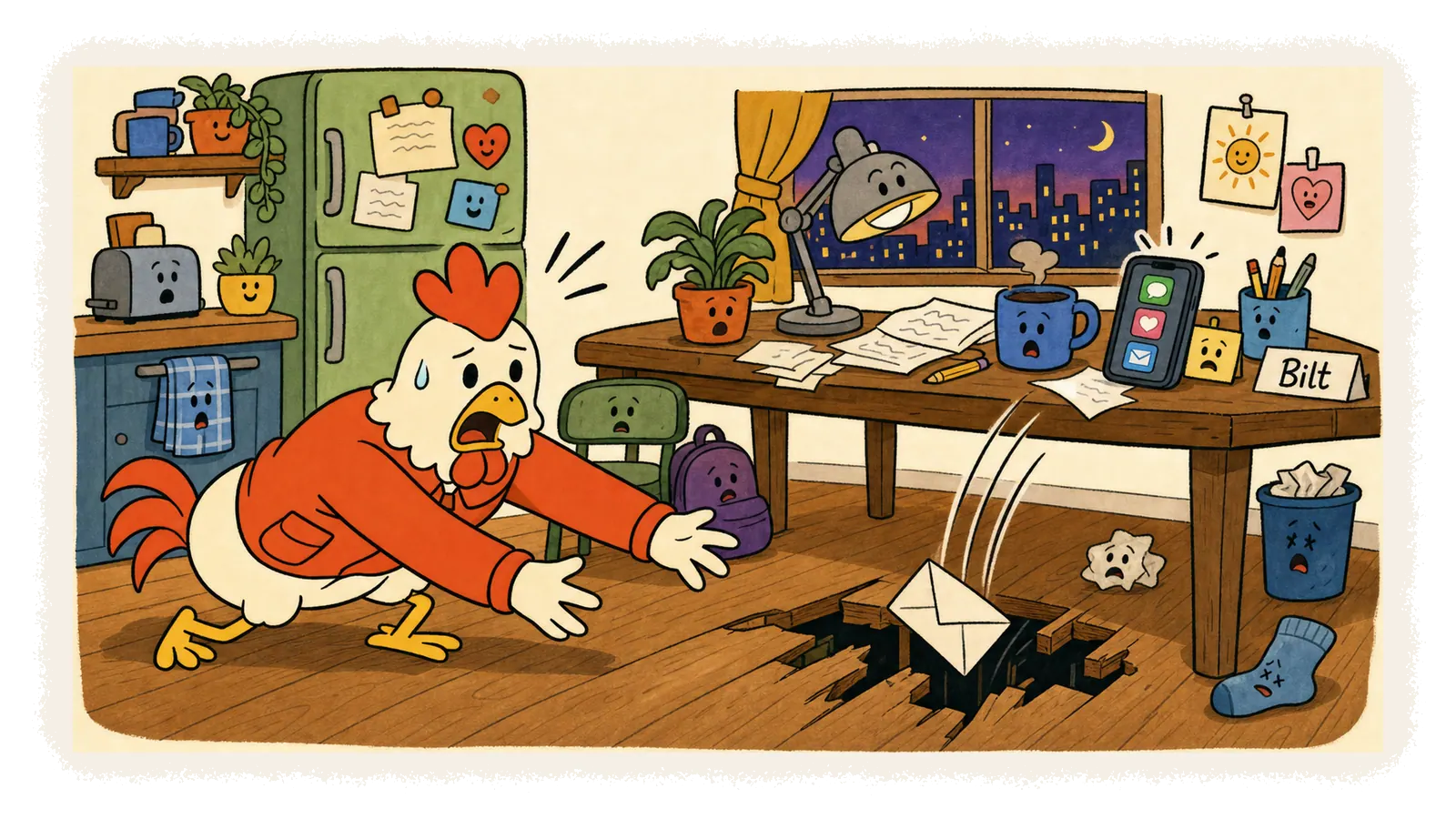
The app said my rent was paid. My bank said the money was gone. My landlord's portal said I still owed. Three screens, three different answers, and one very real late notice sliding under my door. If you have ever watched a rent payment vanish into the space between a fintech app and the person you actually owe, you know the specific cold feeling I mean.
This is a case log about that gap. In February 2026, Bilt, a rent-rewards fintech that offers credit card products, moved to a new bank partner after an early end to its contract with its former partner bank, Wells Fargo. What should have been an invisible back-office switch became, for some customers, a very visible mess. This piece walks the timeline calmly, separates what is confirmed from what is not, and shows you what to actually do if a payment you made never reached the person it was meant for.
I want to be careful here, because this is the kind of story where rumor outruns fact. I am going to report what has been verified, label every example as an example, and keep the focus where it belongs: on protecting your own nest while the larger story sorts itself out.
What Actually Happened, in Order
Start with what actually happened, in order. Bilt is a rent-rewards fintech that offers credit card products, and its former partner bank was Wells Fargo. In February 2026, following an early end to that contract, Bilt transitioned between bank partners. A bank-partner switch is one of the most delicate moves a card program can make, because the plumbing that moves your money, the account that holds it and the systems that debit and post it, all changes hands at once.
The switch caused a sharp rise in customer complaints to the Consumer Financial Protection Bureau (CFPB), the federal agency that oversees many consumer financial products, and to consumer protection groups. The complaints clustered around two themes: missed rent payments and poor customer service. That pairing matters, because a payment problem is stressful on its own, but a payment problem you cannot get a human to fix is a different kind of storm. Hold onto the sequence, early contract exit, then partner transition, then the surge in complaints, because the order is the whole story, and it explains why the trouble arrived when it did.
Contract ends early
Bilt and Wells Fargo wind down their card partnership ahead of schedule.
Bank partner switch
Bilt moves its card program to a new partner bank, and the money plumbing changes hands at once.
Complaints surge
Reports of missed rent payments and poor chatbot support rise sharply to the CFPB and consumer groups.
CFPB meets Bilt
Officials discuss the transition and elect not to pursue a public enforcement action.
About 500 reimbursed
Bilt voluntarily reimburses roughly 500 newly identified customers for overdraft, late, and insufficient-funds fees.
The Reported Harms: Money Out, Nothing Delivered
The reported harms fall into a few concrete buckets, and it is worth naming them precisely rather than gesturing at chaos. According to reporting, some customers had their bank accounts debited for rent and mortgage payments that Bilt did not then pass on to their landlords. In other words, the money left the customer's account but did not arrive where it was owed, the exact gap I described at the top. When your rent leaves your checking account but your landlord never sees it, you can be hit with your own bank's fees and your landlord's late charges at the same time, through no fault of your own planning.
The second reported harm was the customer service itself. Support was delivered in part through AI-powered chatbots, and those chatbots struggled to resolve the situations people brought to them. A scripted assistant is fine for a password reset; it is a poor match for "my rent is gone and my landlord is threatening a late fee." I am describing these as reported harms and alleged concerns, not as proven legal violations, because that distinction is the honest one and the one that protects you from acting on a rumor.
What the CFPB Actually Did (and Did Not Do)
Here is the part that is most often garbled, so I will state it plainly. CFPB officials met with Bilt to discuss the transition, and the CFPB elected not to pursue a public enforcement action. It did not order, direct, or fine Bilt, and no finding that Bilt violated any law was established. What happened instead is that Bilt proactively contacted potentially affected customers and offered to reimburse fees tied to the transition: overdraft fees, late fees, and insufficient-funds fees. Bilt reimbursed about 500 newly identified affected customers, and its documentation submitted to the CFPB appears to show the transition-related technical issues are resolved. The CFPB published a newsroom post titled 'The CFPB Works To Ensure Bilt Consumers Are Made Whole.'
Voluntary, not court-ordered
Bilt reimbursed about 500 customers on its own outreach. The CFPB met with the company but did not order or fine it, and no finding of any legal violation was established.
Why labor over who did what? Because the difference between "a regulator forced a company to pay" and "a company reimbursed customers voluntarily while a regulator watched" changes what you should expect. If your fees were reimbursed, that came from the company's own outreach, not a court order. And if you were affected but never contacted, the quiet lesson is that you may need to speak up yourself rather than wait to be found.
Were your transition fees reimbursed but you were never contacted?
What a Botched Transition Can Do to a Credit File
Now, what can a botched issuer transition do to a credit file in general? I want to be exact: the effects I am about to describe are the known, general risks of any card program changing hands. They are not confirmed outcomes for Bilt customers, and you should treat them as a checklist to verify on your own reports, not as a description of what happened to anyone in particular. Three things tend to go wrong when an account moves between banks.
First, account age can reset. If the new bank opens what looks like a brand-new account rather than porting the old one, your history's length, a factor that generally helps a score, can appear to shrink. Second, a balance mismatch can appear, where the old and new systems briefly disagree about what you owe, which can distort the ratio between your balance and your limit. Third, a phantom late mark can surface, where a payment made on time is recorded as late because it fell into the seam between two systems. Each of these is a general risk, and each is checkable if you know to look.
Three Transition Risks and How to Check Each
| Transition Risk | What It Looks Like | What to Check on Your Report |
|---|---|---|
| Account age reset | A ported account shows up as brand-new | Compare the open date on your report to your old statements |
| Balance mismatch | Two systems briefly disagree on what you owe | Screenshot the real balance and watch your reported utilization |
| Phantom late mark | An on-time payment is logged as late | Match the cleared date on your bank record to the reported status |
Riley's Utilization Wobble: A Worked Example
The fix is not panic; it is documentation. Riley's job is to screenshot the real balance, save the statement that shows the correct figure, and watch whether the mismatch clears on its own once both systems settle, which, in a clean transition, it usually does. If it does not clear, that saved evidence becomes the backbone of a dispute. I labeled Riley as an example on purpose; the point is the pattern, not any one person's file, and the pattern is one you can prepare for calmly.
Your FCRA Dispute Right Does Not Change
Fair Credit Reporting Act (FCRA)
The federal law that governs the accuracy of your credit reports and gives you the right to dispute inaccurate information.
Why the Gap Stings Twice for Credit Builders
Imagine Nico, a newcomer with a thin file who signed up precisely to start building. If a transition ever made an on-time rent payment look late, the harm to a thin file could be outsized, because a single mark weighs more when there is little else on the report. And picture Dana, mid-move, with a lease application pending, who cannot afford a phantom late mark surfacing this week. Both are illustrations, not reported cases, but they show why the time-sensitive move is the same for everyone: verify now, document now, and do not assume a fix will find you. Ask your provider directly whether and how your rent is reported, because you are entitled to know what shows up under your name.
Keep Your Own Copy of the Facts
So where does the case log leave us? A fintech ended a bank contract early, switched partners in February 2026, and some customers paid the price in missed rent and unanswered chats. A regulator met with the company and chose not to bring a public enforcement action; the company reimbursed about 500 identified customers on its own and told the CFPB the technical problems are resolved. That is the whole verified shape of it, no villain I can name, no law I can say was broken, just a gap that swallowed some people's rent for a while.
Back to those three screens I opened with, each insisting on a different truth. The lesson is not to distrust every app; it is to keep your own copy of the facts. Screenshot the confirmation, save the statement, know how your rent is reported, and dispute with specifics if the record is wrong. Your credit profile is a nest you tend across years, and one bad month of someone else's plumbing does not have to become a permanent crack in it. Watch your own reports, keep your receipts, and take the next accurate step. That is how a gap like this one quietly closes.
Action Items
Disclosure
Some lenders and credit scoring models may filter out, discount, or weigh authorized user tradelines differently in their underwriting decisions. Results vary based on lender policies, the specific scoring model used, and your unique credit profile. An AU tradeline does not guarantee loan approval or any specific credit score outcome.
Frequently Asked Questions
1. Did the CFPB fine or order Bilt to reimburse customers?
- No. CFPB officials met with Bilt to discuss its February 2026 bank-partner transition and elected not to pursue a public enforcement action. The CFPB did not order or fine Bilt, and no finding that Bilt violated any law was established. Bilt proactively contacted potentially affected customers and reimbursed about 500 of them for overdraft, late, and insufficient-funds fees on its own.
2. What went wrong with Bilt's bank transition in 2026?
- In February 2026, Bilt moved to a new bank partner after an early end to its contract with its former partner bank, Wells Fargo. Complaints to the CFPB and consumer groups rose sharply over missed rent payments, including accounts being debited for rent and mortgage payments that Bilt did not pass on to landlords, and poor customer service delivered in part by AI-powered chatbots.
3. How many Bilt customers were reimbursed?
- Bilt reimbursed about 500 newly identified affected customers for overdraft fees, late fees, and insufficient-funds fees related to the transition. No verified total dollar figure for the reimbursements has been reported.
4. Can a card issuer changing banks hurt my credit?
- In general, a card program changing bank partners can reset the account age, create a temporary balance mismatch that distorts your utilization, or add a phantom late mark when an on-time payment falls between two systems. These are general risks to verify on your own reports, not confirmed outcomes for any specific customer.
5. How do I dispute a credit error caused by a bank transition?
- Under the Fair Credit Reporting Act (FCRA), dispute the specific defect with each credit bureau that shows it. Name the account, the date, and the exact error, and attach proof such as a bank statement or confirmation screen. Keep the dispute going if the first response is wrong rather than accepting an inaccurate result.
6. What should I do if my rent was debited but never reached my landlord?
- Keep your own copy of the facts: screenshot the payment confirmation, save the bank statement showing the money left your account, and document the landlord's late notice. Those records let you seek reimbursement of any overdraft, late, or insufficient-funds fees and back up an FCRA dispute if the gap caused a reporting error.